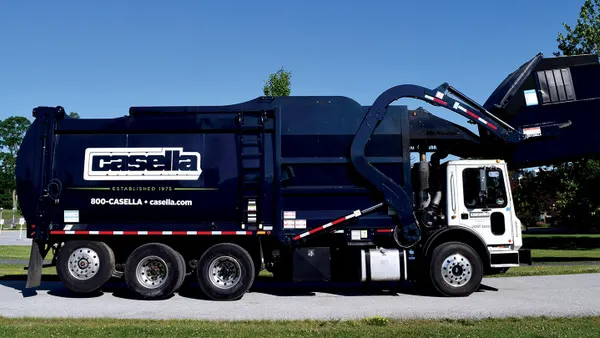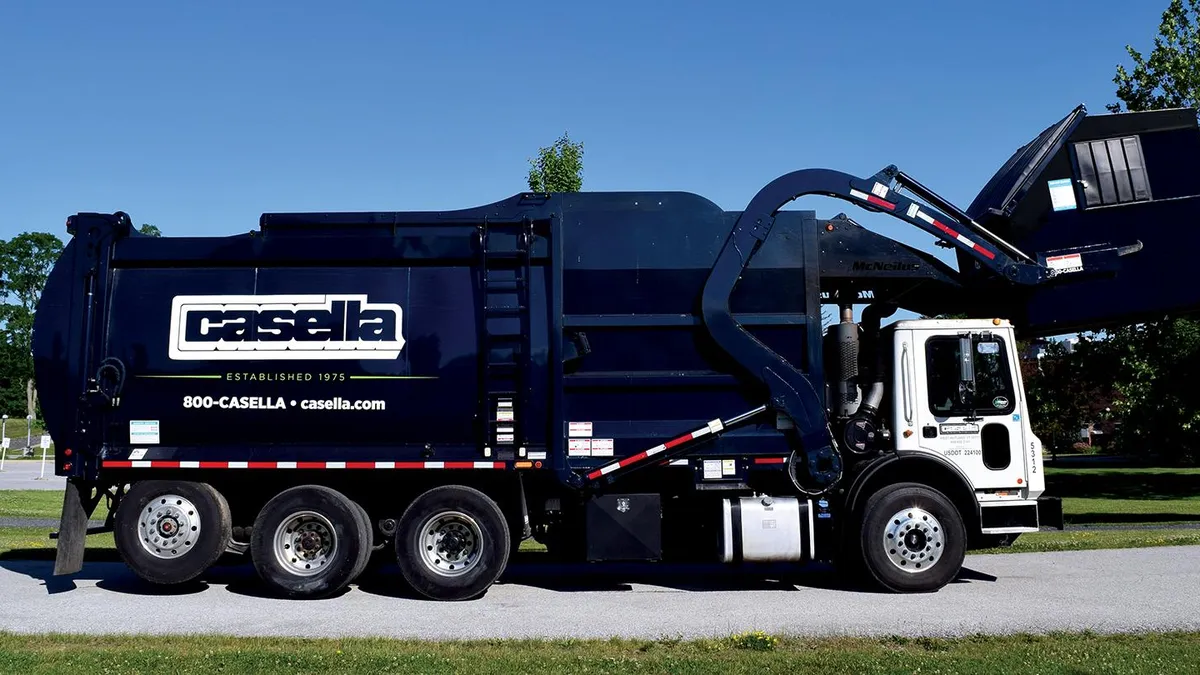
Casella has announced a new plan to improve margins by 300 basis points over the next three years. The “300 in 3” plan aims to reach an EBITDA margin of at least 26% by the end of 2029, executives said on a Q3 earnings call Tuesday.
The plan appears to be a response to demands from activist investor Jana Partners, which wants Casella to commit to achieving 27% earnings before interest, taxes, depreciation and amortization margins by 2029. It also wants Casella to hire a performance improvement consultant.
Executives did not name Jana or reference investor pressure during the earnings call, but noted the plan builds on the company’s existing goal to grow free cash flow by 10% to 15% a year.
“This was not an entirely new plan, but was a framework to bring together key objectives under a unified and coherent company-wide program,” said CEO Ned Coletta.
The 300 in 3 plan has already started, he said. It will likely encompass a wide range of updates related to operations, pricing and sales, and organizational components. It may also affect how the company approaches its M&A strategy and business mix, he said.
CFO Brad Helgeson noted that Casella expects to actually surpass its goal.
“300 basis points is the target that we're laying out and we're committing to publicly, but internally we're shooting for a much higher level,” he said.
Back office and administrative operations have already seen notable changes as part of the new margin plan. That department experienced layoffs in September “to leverage recent targeted investments in AI, enterprise technology and process automation,” Coletta said.
The company incurred $1.4 million in the quarter for what Helgeson described as “organizational transformation costs,” mainly tied to severance. The 300 in 3 plan calls for saving $15 million in general and administrative costs.
“Future periods may include other costs incurred to execute our transformation plans, such as consulting,” Helgeson added. “These will be directly related to the organizational design and back office efficiency.”
Coletta said he set a new standard that each of Casella’s business units must generate at least 15% in operating income. “We have several that are below that target today, and we have some great strategies to get to that level. But if we can't see a pathway, we may choose to sell some businesses or even close them over time, and we believe that will lead to higher capital outcomes over time.”
The company has also changed its fuel surcharge to include a margin recovery component, “which will help us in up and down markets,” Coletta said. It also standardized fees across its business for components like extra pickups and overloaded containers.
The company implemented credit card convenience fees it had announced earlier this year, which started yielding results in October, Coletta said. Casella is on track to generate over $5 million per year of savings in the region by the end of the year, a goal the company mentioned in Q2.
Coletta said the 300 in 3 plan also “greatly extends” Casella’s existing goal to generate $15 million in operational synergies in the mid-Atlantic region.
Casella also replaced some members of the leadership team for the mid-Atlantic region, bringing in a new regional vice president and regional sales manager. Coletta expressed disappointment in how the previous team had handled the Mid-Atlantic integration, but said the new team has more quickly implemented pricing programs and route integrations that had been lagging.
Casella expects to achieve about a 19% EBITDA margin for its mid-Atlantic business by the end of the year, which includes its collection business and its McKean Landfill in Pennsylvania.
Casella also shared several landfill cost updates during the Q3 call. The company announced it would officially “abandon” its plans for the proposed Granite State Landfill, a greenfield project Casella hoped to open in Dalton, New Hampshire.
Casella recorded a $13.6 million write-off during the quarter for the project’s development costs, including legal and engineering costs since 2019.
Coletta called the move a “challenging decision,” but noted the company “did not see a clear path to success given the politicization of the permitting process.”
That landfill project has faced strong opposition from residents and activist groups, leading Casella to withdraw a key wetlands permit application, The New Hampshire Bulletin reported in June.
Casella had originally proposed the Dalton landfill project partly to ease capacity concerns at the North Country Environmental Services Landfill in Bethlehem, New Hampshire. Casella announced in October that it was closing the Bethlehem landfill a year early due partly to airspace factors.
Casella slightly missed Q3 revenue and adjusted EBITDA expectations for the quarter, according to analysts. But Coletta said the company was “highly confident in our operating plans for the year” and raised guidance slightly for revenue to an estimated $2.1 billion to $2.11 billion range.
It now estimates a net loss of between $10 million and $4 million, compared to a previous estimated net income of up to $6 million.