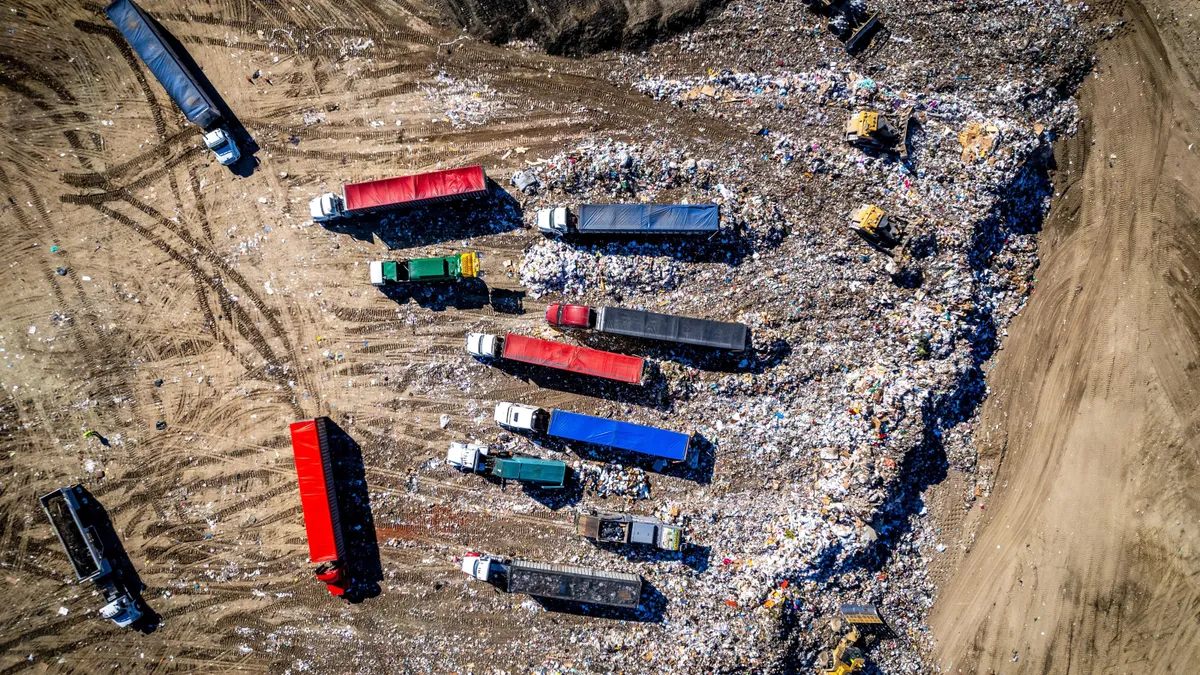
Landfill operators continue to be the focus of scrutiny from environmental groups, particularly over landfill gas emissions and odor issues.
A new report calls for stricter landfill gas rules in New York. Meanwhile, a panel of judges has dismissed some claims from environmental groups that aim to block the expansion of the embattled Seneca Meadows landfill in New York. In Illinois, Rumpke Waste & Recycling celebrated the opening of its new landfill.
What landfill news are you following? Contact us at waste.dive.editors@industrydive.com.
Rumpke opens new landfill in Illinois
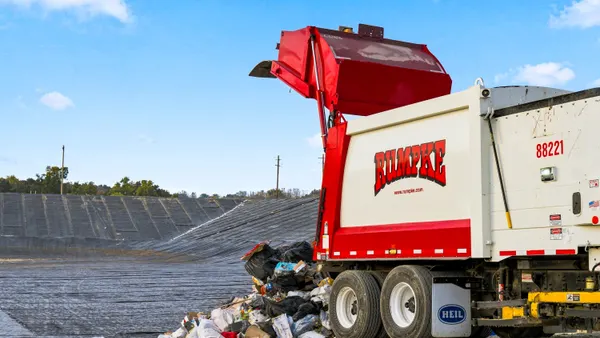
Rumpke Waste & Recycling opened its new Effingham County Landfill in Illinois, which it says will provide about 30 more years of disposal capacity for the region. It accepted its first load on October 26.
The landfill footprint is about 100 acres, with 40 acres permitted for municipal solid waste and C&D waste disposal. The landfill is permitted to accept municipal solid waste and construction and demolition debris. Hazardous waste is not accepted.
The new landfill is also meant to replace Rumpke’s nearby Landfill 33, which is “approaching its final disposal capacity,” the company said in a news release. Rumpke plans to close that landfill in the next few years and transition operations to the Effingham County Landfill.
Rumpke acquired Landfill 33 in 2024 when it expanded its footprint into the state with the acquisition of Sanitation Service, a family-run company. Sanitation Service owned Landfill 33 and was in the process of building the Effingham landfill when Rumpke acquired it.
Rumpke is placing an initial layer of household waste at the new site in an effort to protect the underlying liner system. Rumpke plans to start “routine disposal,” including bulky or large items, in spring 2027. Rumpke will continue disposing of C&D debris at Landfill 33 until that time, the company said.
“Our goal was to develop a safe, compliant and reliable disposal site for the region and it’s incredibly rewarding to see the project come to fruition,” said Austin Hayes, landfill manager for Rumpke, in a statement.
Construction began in October 2024, and Rumpke received its final permit approval from the Illinois Environmental Protection Agency in mid-October 2026.
The property also includes a scale house, heavy equipment maintenance building, wheel wash station and sediment pond.
Rumpke is in the process of pursuing another landfill expansion project in Montgomery County, Kentucky, which has an estimated seven and a half years of capacity left. Residents have pushed back on that expansion proposal, prompting Rumpke to scale back its proposed plan.
Judge panel rejects claims in ongoing Seneca Meadows landfill lawsuit
A panel of judges in the New York Supreme Court’s Appellate Division have sided with the operators of the Seneca Meadows landfill and the New York State Department of Environmental Conservation over several aspects of an odor complaint lawsuit.
Waste Connections operates the landfill, the largest in the state. Environmental group Seneca Lake Guardian, two businesses and two people who live near the landfill sued Waste Connections and DEC. They allege that the landfill “persistently produces offensive odors and other adverse conditions” that negatively affect their community and local businesses.
These groups claimed the DEC violated the state’s Green Amendment — a law guaranteeing "the right to clean air and water, and a healthful environment” — by failing to require SMI to address these odor issues.
The group also sought to block SMI’s pending permit application to expand the landfill, calling for the landfill to immediately stop operations to address the environmental issues. Waste Connections wants to significantly expand the landfill to extend its life by 15 years.
But a four-judge panel said the attempt to block the pending permit expansion was premature because the Department of Environmental Conservation hasn’t yet finalized its permit application review.
The two businesses, plaintiffs Waterloo Contractors and Absolute Auto Repair, argued that they “sustained economic losses” because of the landfill’s noxious odors and because of frequent visits from gulls that flew over the landfill. But the judges said there was not enough evidence to show the businesses were “uniquely affected” by the odor complaints in a way that was different than those experienced by the wider community.
The judge also found that the Green Amendment argument didn’t hold up because SMI is a private party, and DEC was not held responsible for SMI’s landfill management actions.
The judges’ ruling isn’t the end of the ongoing Seneca Meadows lawsuit. In the ruling, the judges left the door open for the plaintiffs to collect more specific evidence to strengthen its private nuisance claims. Seneca Lake Guardian has said it will continue to fight the landfill’s expansion efforts.
Advocates push for New York landfill gas rule update
A new report released by nonprofit Full Circle Future on Thursday scrutinizes air emissions from New York landfills and calls for more stringent regulations that rise above federal minimum standards.
The report took a close look at monitoring records from 16 of the state’s largest landfills. It found that several landfills reported highly variable landfill gas emissions but were not required to consistently monitor their gas wells or surface due to technicalities in the reporting process.
“Landfill regulations are largely built on an honor system,” Elizabeth Schroeder, director of communications with Full Circle Future. “We went into this exercise asking how is that honor system working in practice, and what we found is that actually, it’s not working very well.”
The group has supported enhanced air emission regulations in other states, which have begun to push ahead of the U.S. EPA. That includes Colorado’s Regulation 31 and California’s updated Landfill Methane Regulation, both of which were finalized last year.
Under current rules, landfills are required to report gas sampling every five years. Provided non-methane organic compounds in the sample fall below 34 metric tons a year, the landfills are not subject to enhanced monitoring requirements. These include quarterly surface monitoring for leaks, monthly cover inspections, gas well temperature limits and other requirements.
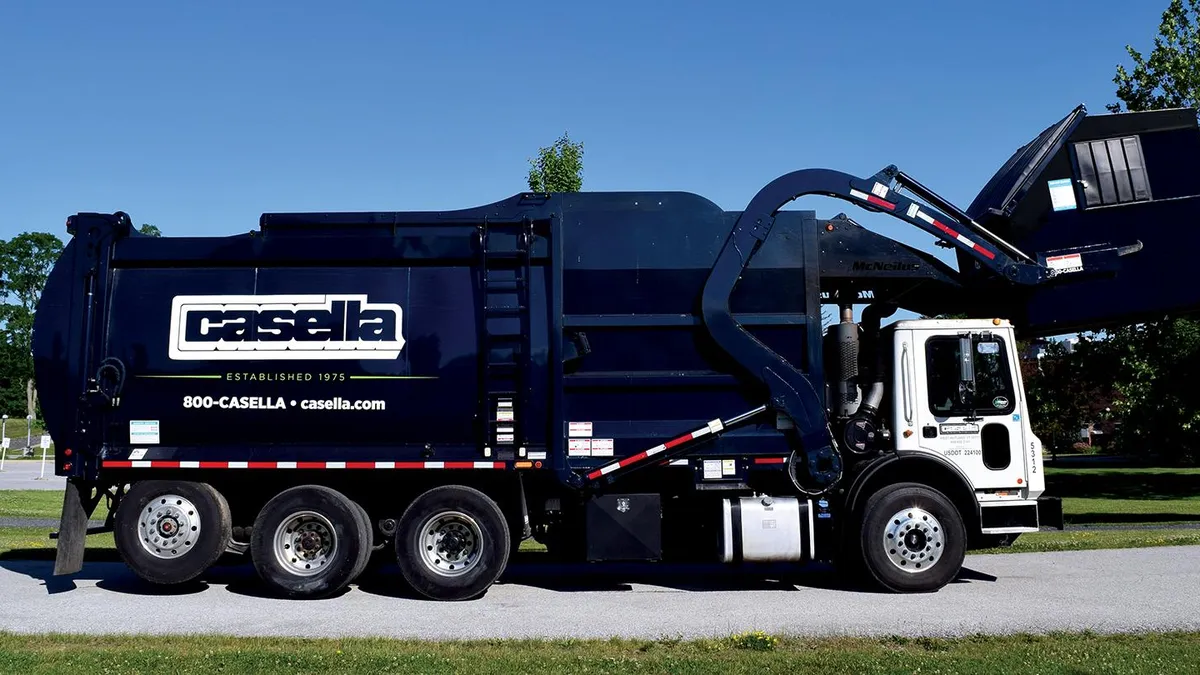
Over a five-year period, gas levels can rise above the threshold, Full Circle Future found in monitoring records with the state. It noted that the Chemung County Landfill, operated by Casella Waste Systems, holds about 6.5 million tons of waste and released 968 million cubic feet of gas in 2024, roughly 17 times the level at which states like California and Washington would have required enhanced operational and monitoring standards.
The landfill surpassed the federal threshold through its 2024 reading and now has until 2027 to comply with enhanced monitoring standards.
New York’s Department of Environmental Conservation held a meeting in June to gather information for a potential update to its landfill gas rules. During the meeting, department staff expressed interest in pursuing regulations similar to those in California and Colorado, which gives advocates hope that New York will tighten its standards, said Lee Helfend, director of campaign strategy at Full Circle Future.
In addition to more gas collection and control system requirements with a methane emissions threshold, the group is also advocating for the use of technology like aerial monitoring and wellhead data collection.
“There is real opportunity to increase the scope of technology that we're really leaning on for the management of these landfills,” Helfend said. “This is going to mark hopefully a new standard, not just for the state but nationwide as well.”
Other landfill news
- The Minnesota Pollution Control Agency has fined the Crosslake Construction Demolition Debris Facility $20,000 for violating solid waste permit requirements between 2020 and 2022. That includes not adequately covering waste materials and accepting prohibited materials like electronics and cleaning solvents. (KAXE)
- Region 2000, a joint authority in central Virginia, has voted to expand the Livestock Road Landfill, set to reach capacity by 2029. The move would add 60 acres and about 24 years of life. Some neighbors have protested the move. (WSET)
- Alabama environmental regulators are proposing a $38,600 fine against the operators of the Axis Industrial Landfill in Mobile County, Alabama. The Alabama Department of Environmental Management said pools and seeps of liquid from the landfill reached nearby wetlands, among other issues. (NBC 15)
- The closed Kansas City Sanitary Landfill in Kansas will get a new $700,000 landfill gas collection system. That landfill operated from 1972 to 1974 and needs a new system to accommodate higher detected methane levels. (Waste Today)