Dive Brief:
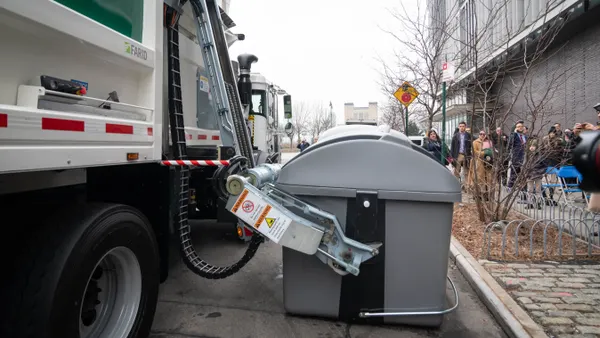
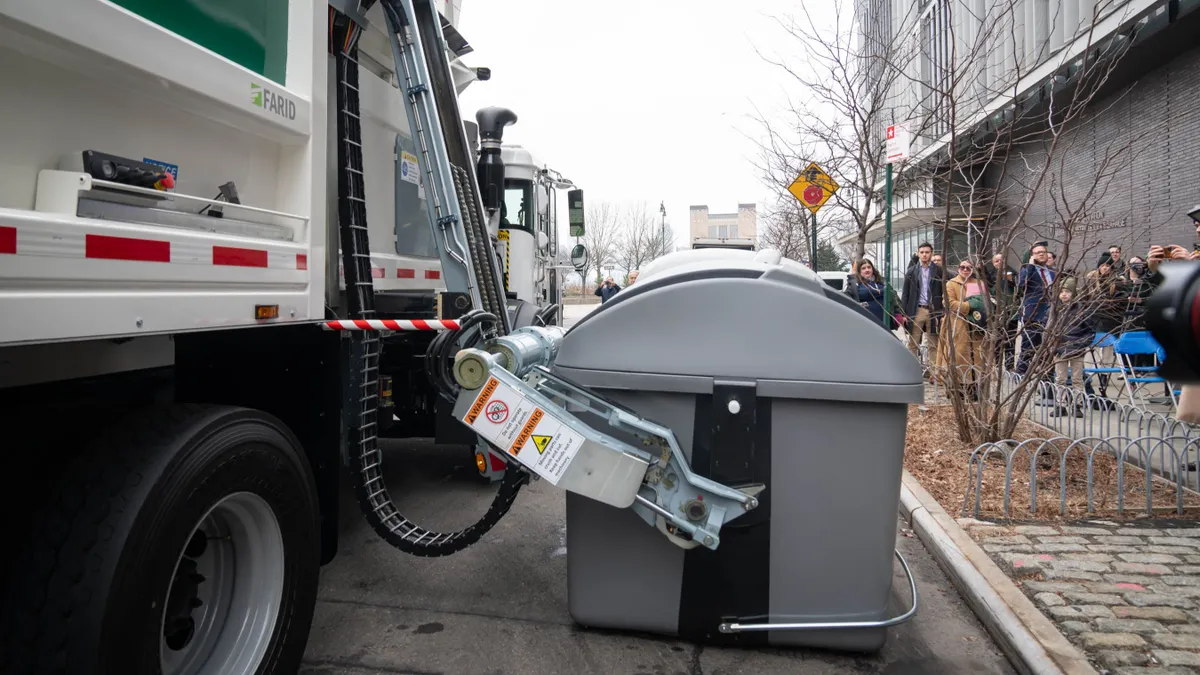
- New York City’s Sanitation Department announced a plan Thursday to charge many multifamily building owners up to $55 per Empire Bin annually. The bins, manufactured by Contenur, are one of the key tools the city has unveiled to containerize trash from the city’s large residential buildings.
- The fee proposal includes exemptions for certain kinds of buildings, including those that are run by the New York City Housing Authority and those that are covered by the state’s Mitchell-Lama affordable housing program.
- The city has deployed Empire Bins in two pilot areas of Manhattan and Brooklyn so far. On Oct. 20, DSNY separately proposed an expansion of the Empire Bin program to Queens Community District 2 and Bronx community districts 2 and 5.
Dive Insight:
New York City is aiming to containerize its waste by 2032, a commitment Mayor Zohran Mamdani made in April. But the rollout of containerization has seen hiccups, including the recent bankruptcy of Otto, the manufacturer of the wheeled NYC Bins that are required for single-family homes and buildings with up to nine units.
The Empire Bins have seen a limited rollout so far, but DSNY continues to explore an expansion of their use as it looks to meet the deadline. The bins can hold up to four cubic yards of waste and have led to a decline in rat sightings in neighborhoods where they’re deployed, according to city officials.
To date, DSNY has installed more than 1,000 Empire Bins in Manhattan Community District 9, and is in the process of installing 700 Empire Bins in Brooklyn Community District 2 this fall, according to a spokesperson.
DSNY Commissioner Greg Anderson said in a statement that the agency is authorized to set the Empire Bin fee under Local Law 180, which also allows the department to expand the containerization program to more areas.
“This will make for a cleaner, more livable city,” Anderson said. “Certain of the largest buildings will be asked to pay a nominal per-unit fee to cover some of the costs, just the same way that small buildings are responsible for the cost of their wheelie bins.”
The newly announced fee is designed to cover installation and maintenance, not the cost of collection or the automated side-loading trucks used for the bins. Those trucks utilize a specialized design, and the city signed a $25 million contract with Gabrielli in January for their supply.
Officials have not yet determined an exact price they will charge for the Empire Bin fee, though $55 is the maximum allowed under the law. They note the fee will be similar to the price of the wheeled NYC Bins, which must be purchased individually through retail outlets.
DSNY’s proposal to roll out Empire Bins in new districts is also authorized under Local Law 180. Buildings with at least 30 residential units in the newly covered districts would be required to containerize their waste with the Empire Bins by June 30, 2027.
In line with earlier stages of the rollout, medium residential buildings with 10 to 30 units have flexibility to containerize with several rolling bins instead of Empire Bins, provided they meet the deadline. The application period for medium buildings to receive Empire Bins is proposed to run from Jan. 2 to Feb. 28. DSNY plans to install the Empire Bins beginning April 1.
As for the fee, the agency is still working out details and an exact rollout date. A spokesperson confirmed that buildings already using the bins in Manhattan and Brooklyn won’t be immediately charged.