Dive Brief:
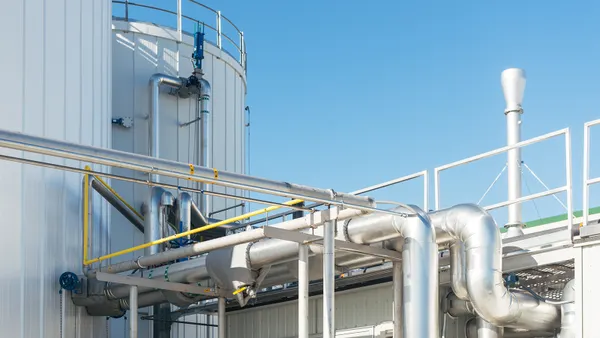
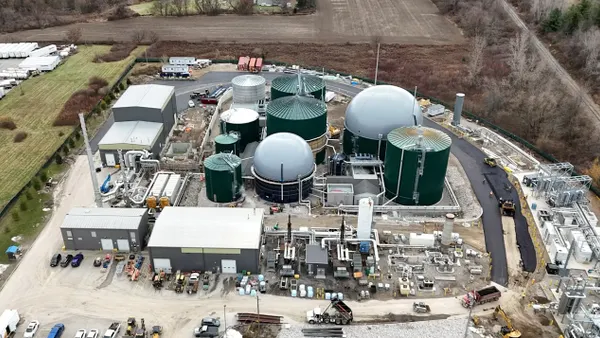
- Divert acquired two anaerobic digestion facilities late last month. Anaergia announced the facility sale on Oct. 1, but hadn’t disclosed the buyer. Divert previously declined to comment.
- The Rhode Island Bioenergy Facility sale was confirmed via a message shared with customers as well as by the state’s Department of Environmental Management. The Charlotte Bioenergy Facility sale was confirmed by the air quality division of Mecklenburg County, North Carolina.
- Anaergia reported the deal would remove approximately 20 million Canadian dollars in debt from its balance sheet. It also received 9 million Canadian dollars of equity in the buyer.
Dive Insight:
The broader biogas market continues to attract investor interest, but the churn in ownership of some facilities is indicative of the potential profitability challenges.
This is the latest in a series of moves by Anaergia to streamline its portfolio in recent years, largely moving away from direct facility ownership to operating contracts and other models.
The first of its notable divestitures was the sale of a digester in California to Sevana Bioenergy in 2024. Sevana, facing its own financial challenges, sold that site to Berq RNG just weeks ago.
The recently sold Charlotte, North Carolina, and Johnston, Rhode Island, facilities have a complex backstory of shifting financial interests, delayed construction and related challenges.
Developer Orbit Energy originally sold an interest in the facilities to Blue Sphere, which later entered a joint venture with York Capital Management, before the sites were sold to Anaergia in 2021. Anaergia paid $1.7 million for the Rhode Island site at the time.
The North Carolina site started operating in 2016 with more than 120,000 tons of capacity per year. The Rhode Island site which has 100,000 tons per year of capacity, opened in 2018 and was described as the largest of its kind in New England at the time.
Anaergia originally announced plans to upgrade each to support renewable natural gas generation. At the time, it noted the North Carolina site had a long-term power purchase agreement with Duke Energy until 2031. Anaergia idled the North Carolina site in 2024 and did not advance RNG upgrade plans.
The company did invest in RNG production at the Rhode Island facility, announcing a $20 million loan to continue work in 2023 as well as an offtake agreement with Irving Oil. The facility was operational until the sale. Divert’s recent email to customers in Rhode Island noted it would temporarily stop taking material in order to complete unspecified work to meet compliance standards.
The Rhode Island organics market has grown unevenly in recent years, due to a commercial organics diversion law that has no enforcement mechanism for generators. That’s starting to change, partially thanks to an infusion of grant money spurring more local collection programs and composting infrastructure. North Carolina does not have a statewide organics diversion law.
Massachusetts-based Divert currently operates multiple anaerobic digestion and depackaging facilities throughout the country. It broke ground on a project in Lexington, North Carolina, last year and opened a facility in Washington this year.
In 2021, Divert was acquired by private equity firm Ara Partners. In 2023, it announced a large infrastructure agreement with Enbridge to scale construction of its digesters. Earlier this year, it announced a series C funding round led by Mitsubishi that reportedly valued the company at $1 billion.
M&A in the broader organics market has also been active, including Ara’s recent purchase of a majority stake in crop residue management company Pacific Ag.
Jacob Wallace contributed reporting to this story