Dive Brief:
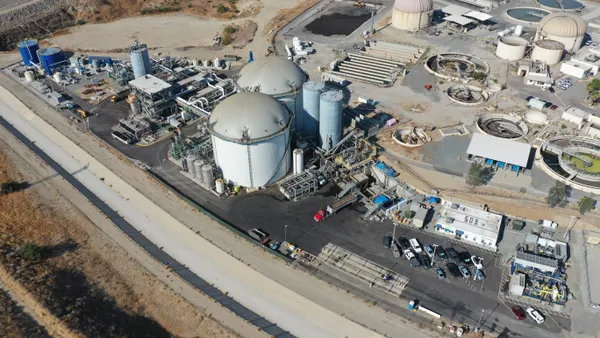
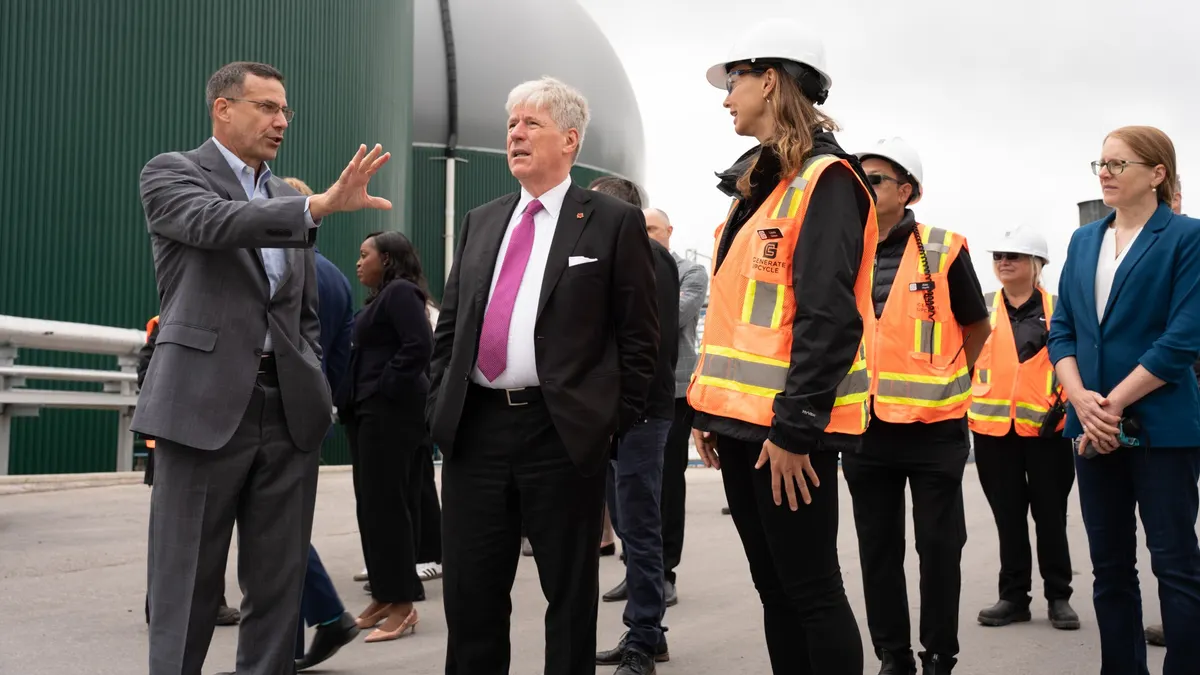
- Generate Upcycle received a loan investment totaling 18.8 million Canadian dollars from Natural Resources Canada’s Clean Fuels Fund to help finance an expansion of its food waste digester in London, Ontario. The investment enables continued progress on a 70 million Canadian-dollar project that will grow capacity at the site.
- The project is expected to triple the amount of renewable natural gas produced at the London Anaerobic Digester & Biogas Plant to 832,000 gigajoules annually. Previous work has already expanded the facility significantly since it was commissioned in 2012.
- At full capacity, the facility will be able to process up to 1,000 tons per day of organic waste. Bill Caesar, president of Generate Upcycle, said supportive policy at multiple levels of government has fueled the facility's growth.
Dive Insight:
The Canadian federal government has ramped up its support for biofuels in recent years as it works to create jobs and support economic development tied to its climate regulations. In the country's 2021 budget, it earmarked 1.5 billion Canadian dollars over five years to establish the Clean Fuels Fund, which would provide financing for projects across development stages at multiple points in the supply chain.
The London digester's public financing comes as a four-year loan backed by Natural Resources Canada which Generate Upcycle must begin paying back once it begins generating a profit. Generate Upcycle is covering the rest of the bill for the expansion with its own funds.
Minister of Energy and Natural Resources Tim Hodgson said the investment would help bring online another project that would build Canada into an energy superpower.
"By supporting projects like Generate Upcycle’s RNG facility, we are leveraging homegrown innovation and existing resources into reliable, low-carbon energy while growing domestic clean fuel production and creating jobs — a win-win-win," Hodgson said in a statement.
The first phase of the expansion, completed in 2024, expanded the site's biogas upgrading system and RNG production capacity. The second phase, which is currently underway, expands the front-end feedstock receiving and anaerobic digestion infrastructure.
Caesar said the site has been operating at the same time as the expansion, but it has not yet been able to achieve full run rate. He expects that will happen in January, with final fine tuning complete in the first quarter of next year.
The full expansion will more than double capacity at the site. It accepts a mix of post-consumer organic waste from municipal contracts and food waste from commercial and industrial partners, helping the region meet its diversion plans.
"It's the material that is the core of what Ontario is keeping out of landfills," Caesar said. "They're not having to build new landfills. A meaningful portion of the overall MSW, the organic fraction of MSW, is never making it to a landfill."
Generate Upcycle launced in 2022, when Generate Capital acquired the food waste to energy division of alternative fuel producer StormFisher. The latter company was the original developer of the London site.
This is the latest expansion Generate Upcycle has made to its portfolio of facilities across North America and the United Kingdom. Last year, the company also completed an expansion at its Cayuga, New York, digester, a facility that now produces 195,000 mmBtus of RNG annually. The company invested $30 million in the upgrades, some of which was supported by federal Investment Tax Credits generated at the site.
Caesar said supportive public policy helps the anaerobic digestion sector in North America mature more quickly, especially as it lags behind progress in Europe. Over time, he hopes that the new projects will convince more policymakers and communities to embrace anaerobic digestion as an organic materials solution.
"It does reduce the risk of an investment, and it helps people demonstrate the utility of food waste-based anaerobic digesters," Caesar said. "This is part of what you do to get an industry off the ground."