Oregon aims to divert more mattresses from disposal and curb illegal dumping now that its new mattress stewardship program is up and running.
Oregon is the latest state to adopt such a program since Connecticut started a similar program in 2015 and Rhode Island and California followed suit in 2016. The Oregon program started on Jan. 1.
The program allows consumers to drop off any mattress, regardless of its condition or how old it is, at dedicated locations throughout the state. The Mattress Recycling Council, an industry-led nonprofit organization that operates the program in each state, is in the process of adding more collection locations in Oregon and connecting with additional recycling partners in coming months.
“We're sort of boutique in the world of EPR, in that we're less than 1% of the solid waste stream, but we're bulky and inconvenient,” said Mike O’Donnell, MRC’s chief operating officer.
“Solid waste facilities don't love mattresses. For us to remove them from their solid waste stream removes a problem.”
Oregon passed the Mattress Stewardship Act in 2022, which called for mattress producers, importers and distributors to register with MRC and become responsible for the collection, transport and recycling of discarded mattresses. In Oregon, consumers pay an assessment fee of $22.50 when they buy a new mattress, which pays for the program. The Product Stewardship Institute, Association of Oregon Recyclers and other organizations supported the bill.
In the next two years, MRC expects recyclers will process more than 374,400 mattresses in Oregon, while approximately 828,224 new mattresses are estimated to be sold during that same time period, according to the mattress recycling program plan.
MRC estimates it has recycled more than 15 million mattresses over the past 10 years throughout California, Connecticut and Rhode Island’s programs.
MRC uses data and insight from the other states’ programs to predict how Oregon’s operations will unfold over the next few years, O’Donnell said. MRC expects a surge of mattresses in the system in the first year, but that number is expected to level off after the second or third year, even as they add more collection options throughout the state.
“We want consumers to have access to mattress recycling year round, and it takes some time to build the collection network,” O’Donnell said.
Oregon prefers to focus on establishing permanent collection sites over offering periodic collection events, though those types of events can be a good short-term solution in areas without as many collection service options, such as rural or otherwise underserved areas, he said. Residents can find the nearest option on MRC’s Bye Bye Mattress website.
“In Connecticut and Rhode Island … it was achievable for us to get really good statewide [collection service] coverage in a reasonably short amount of time. And in California, even today, our coverage is 99% of the state,” he said.
The program also encourages consumers to give their old mattress directly back to a retailer when they have a new mattress delivered to their home. “It can be very convenient for them to take away your old mattress at that time,” he said.
MRC currently contracts with three recyclers in Oregon to process the mattresses — Environmentally Conscious Recycling, St. Vincent de Paul and Klamath Works — which were already offering mattress recycling services prior to the start of the stewardship program.
“We're always looking for those in the solid waste industry to participate in the network in Oregon, and also throughout the California, Connecticut, Rhode Island programs,” said Amanda Wall, MRC’s director of marketing. “That always helps us increase convenience.”
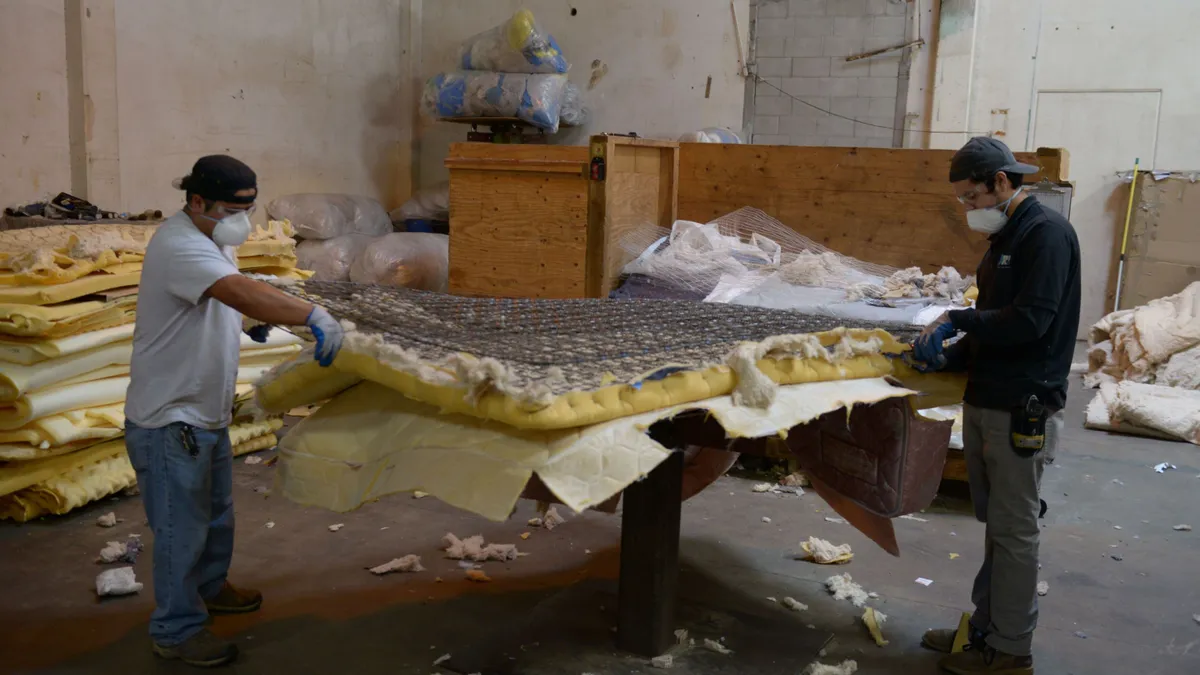
O’Donnell said about 75% of a mattress can be recycled, with springs often going to scrapyards and sold into ferrous markets, while the foam is traditionally sold to manufacturers of materials like carpet padding.
As carpet padding sales are projected to decrease in coming years, O’Donnell said the industry is monitoring how emerging technologies such as chemical recycling could play a role on the market. MRC also sponsored a project to study how a process called vitrimerization could convert polyurethane foam into material for products like shoe soles and phone cases.
At the same time, numerous states are expected to consider similar mattress recycling legislation in coming years, O’Donnell said. Some interested states include Maryland, Virginia, Washington, Massachusetts, New Jersey and New York, but it's unclear what progress each of those states might make in 2025. Massachusetts has banned mattress disposal and will establish a special legislative commission to research EPR options for mattresses and other materials.
“It's quite a long path, and right now there's a lot of competing bills,” O’Donnell said. “2025 is going to be challenging.”
This story first appeared in the Waste Dive: Recycling newsletter. Sign up for the weekly emails here.