
Dive Brief:
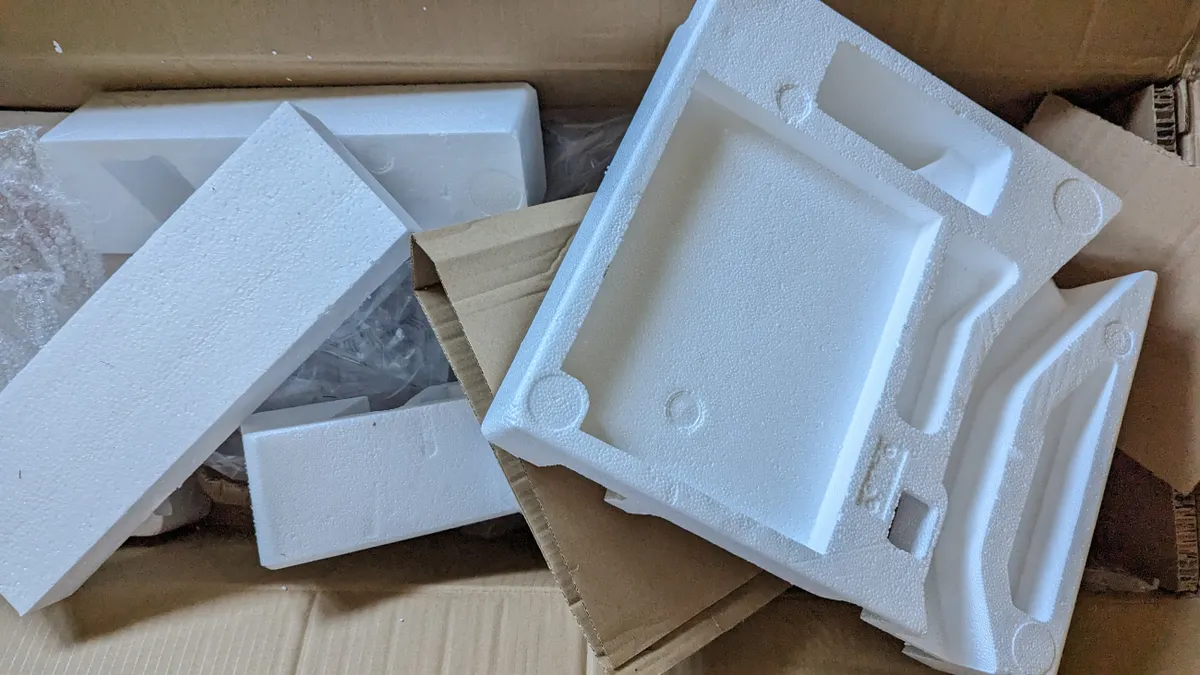
- The Polystyrene Recycling Alliance is calling on the U.S. Plastics Pact to remove two items from its Problematic or Unnecessary Materials list.
- PSRA requests the reclassifications for expanded polystyrene transport packaging and rigid polystyrene packaging, based on a report the group released this week with use cases for those materials collected for recycling.
- USPP will “review this new information accordingly,” Crystal Bayliss, interim executive director, told Packaging Dive via email. To date, USPP has not removed any items from the four-year-old list, she added.
Dive Insight:
PSRA had Resource Recycling Systems conduct the end markets study with the intent to develop an inventory of U.S. and Canada-based end markets for many types of polystyrene. The group aims to accelerate recycling for these products and noted that end markets willing to accept the materials are a key part of the equation.
PSRA says the study shows that both EPS transport packaging and rigid polystyrene packaging are “recyclable today, backed by growing infrastructure, expanding end markets, and continued industry investment,” according to a news release. The study results showed that 81 companies with 119 total facilities already handle expanded or extruded polystyrene foam, with 52% of them being manufacturing end markets that use EPS or XPS as a feedstock to make recycled transport packaging or consumer products.
EPS from the transport sector has a 31% recycling rate in North America, according to PSRA, and is supported by a nationwide network of more than 700 drop-off locations and business-to-business recovery systems. The material’s main recovery through commercial and drop-off channels, instead of residential curbside collection, means transport EPS is less contaminated, the group says.
The study also identified 45 companies with 50 facilities that handle recovered “general purpose” PS and high-impact PS. These denser types of material are commonly used in consumer-facing applications, including food packaging such as yogurt cups, produce containers, bakery clamshells and other foodservice items.
These products are already being collected and recycled across the country, PSRA says. About 13% of the surveyed companies use recovered GPPS and/or HIPS as recycled feedstock for consumer products.
“Polystyrene is a valuable, recyclable resource with a clear pathway to circularity, and plays a critical role in the emerging circular economy for plastics,” said Justin Riney, PSRA chair, in a statement. “The focus should be on scaling solutions and investing in the systems that are already working. That’s exactly what these business cases are designed to support.”
Both rigid polystyrene and EPS are compatible with various mechanical and chemical recycling procedures, PSRA says. Plus, it says that this packaging, “which is comprised of 95–98% air, often has lower lifecycle greenhouse gas emissions than heavier alternatives.” Replacing these materials “can increase emissions, packaging volume, and product damage.”
The U.S. Plastic Pact’s mission is to advance plastics circularity by fostering collaboration across plastics value chains. The member group first released its list of problematic or unnecessary materials in 2022, identifying 11 plastic packaging items that were “not currently reusable, recyclable, or compostable at scale in the U.S.” It called for those items to be phased out by 2025. The list is intended to “identify materials that face barriers to circularity within today’s systems and to inform ongoing innovations across the value chain,” Bayliss said via email.
That list and how the items on it are addressed has evolved over time. In 2024, USPP noted that it had changed how participants report progress on eliminating items on the list. While the previous metric looked at the percentage of all plastic packaging that participants placed on the market which did not contain items on the list, the revamped metric considered the percentage of participants who did not sell any items on the list.
That reporting change resulted in a notable year-over-year drop from 92% in 2022 to 22% in 2023 — with the 100% by 2025 target unchanged. As of USPP’s most recent progress report, released in January, 29% percent of participants did not sell any items on the problematic or unnecessary list. The new goal is 100% by 2030.
USPP evaluates materials “through a fact-based process grounded in science, data, and real-world system performance,” Bayliss said. “As part of our standard process, the relevant workstream has recently reconvened for its scheduled review and reassessment of the list.”
She added that USPP appreciates participants’ engagement in areas such as “contributing data, participating constructively across the value chain, and helping advance practical solutions that support a more circular system for plastic packaging.”
PSRA said in the news release that it wants to collaborate with USPP and stakeholders on topics such as expanding investment in collection and recycling infrastructure, increasing transparency and connectivity across end markets, and advancing innovation in recycling technologies.