Dive Brief:
- WM is expanding autonomous landfill equipment operations at its Marana Regional Landfill in Marana, Arizona, a move it says is a first for the industry.
- WM first launched a pilot in 2025 to use Cat Command remote control technology to autonomously operate a bulldozer to move waste. That pilot, a collaboration with equipment manufacturer Caterpillar, has helped improve landfill safety and efficiency, the companies said.
- WM will now test a Caterpillar-developed autonomous landfill compactor as the next phase of the project. Operators will use insight from the expansion to set up “additional autonomous solutions in landfill operations,” WM said in a news release.
Dive Insight:
WM executives have been hinting at plans to add autonomous equipment and vehicles to its operations for several years, and the Marana landfill project is the first one to test the company’s vision. The autonomous bulldozer is actively operating at that site.
The appeal of remote-controlled technology is to make labor-intensive jobs more comfortable and safe, said Vu Nguyen, WM’s director of emerging technology, in a video explaining the project.
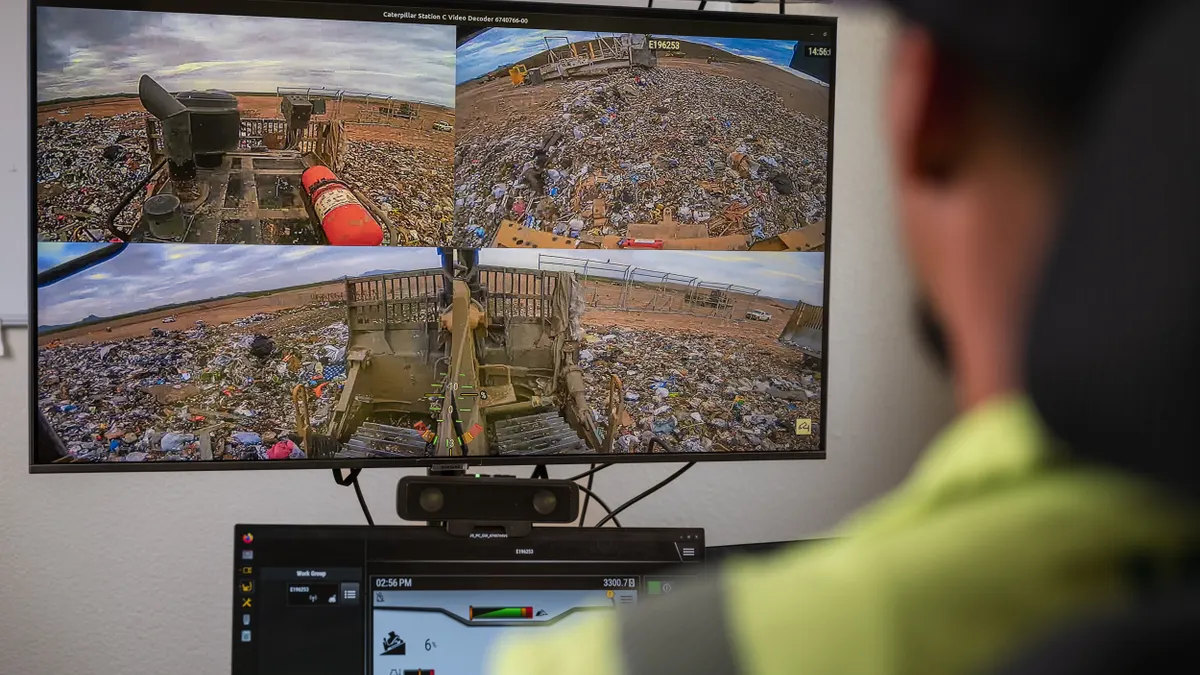
The autonomous vehicle’s operator can sit in a climate-controlled room instead of a bulldozer cab, and cameras attached to the dozer can give operators an almost 360-degree-view of the worksite from multiple computer screens, Caterpillar said.
The technology helps make workers more productive without drastically changing day-to-day operations, Nguyen said. “We use technology to enhance and make our operators more comfortable, but the operation is the same,” he said.
Eventually, Nguyen said, “We think about the frontline employee of the future being able to potentially control multiple pieces of heavy equipment.”
John Morris, president of WM, said in a statement that expects this to be the first of several new programs. "As these technologies evolve, we see significant opportunity for operators to oversee a range of remotely-controlled and autonomous equipment across sites,” which he said would both enhance safety and efficiency while also helping workers “advance their careers with new skills.”
In a 2025 interview with Waste Dive, Morris discussed the autonomous equipment pilot, saying a broader-scale program could also potentially address labor shortages.
“If you have a facility in the middle of nowhere, a very hard-to-access place, it’s gonna be hard to get labor. However, maybe you can put someone in a chair in what looks like a gaming room, they can run the equipment from anywhere,” he said.
CEO Jim Fish has been discussing possibilities for the technology since at least 2019, when he mentioned an autonomous vehicle pilot with Caterpillar in the Denver area.
It’s not clear how much WM expects to invest in the program, and the company did not provide additional details as of press time.
During WM’s Q2 earnings call on July 28, Morris characterized the autonomous equipment project as part of a long-term way to save money through a range of tech innovations.
“We are also continuing to innovate for the future through AI-enabled tools, autonomous long-haul vehicles and remote-operated heavy equipment, all of which we expect to support higher revenue capture, lower operating costs and sustained margin expansion over time,” he said.
WM is already currently using artificial intelligence in applications such as its Smart Truck routing efficiency software, which has already generated more than $300 million of annual run-rate earnings through lower operating costs and service upgrades, Morris noted during the earnings call.