Dive Brief:
- The U.S. EPA plans to create a publicly searchable PFAS “navigator” tool designed to help state and local leaders more easily find information on PFAS destruction and disposal technologies.
- The interactive tool, dubbed the Break the Bond Navigator, aims to offer more real-time updates than the agency’s annual interim guidance document. The agency envisions the tool will be updated on an “ongoing basis” with data on research findings and technological advancements.
- The navigator is still under development, and it’s not clear when it could launch. EPA officials offered new details on the navigator project and took feedback from state and local officials during the annual meeting of the Association of State and Territorial Solid Waste Management Officials last week in Arlington, Virginia.
Dive Insight:
The navigator tool is the next step in the evolution of the U.S. EPA’s strategy for collecting and publishing information about the latest available technologies for managing per- and polyfluoroalkyl substances.
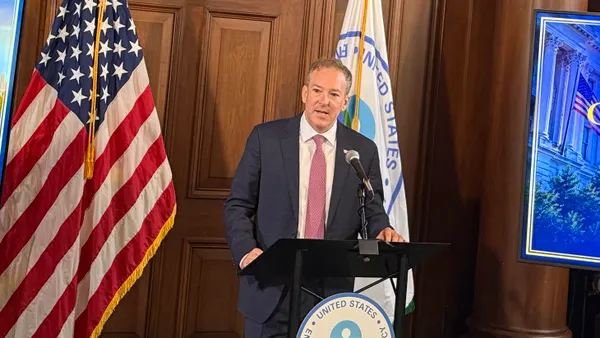
The agency under the Trump administration has said it’s been focused on accelerating the pace and scope of PFAS-related research, mainly by partnering with outside agencies and private industry. EPA Administrator Lee Zeldin has said PFAS technology has made “extraordinary” advancements in the last 20 months.
But the agency has also faced criticism from environmental groups over the rollback of PFAS-related rules for drinking water, as well as calls to focus more research and data on sewage sludge issues.
The EPA first announced the navigator tool as part of its broader PFAS Technology Evaluation, Coordination, and Harmonization Strategy, a plan announced last week. EPA envisions the plan will help “inform on-the-ground decision-making” by advancing a range of pilot programs, establishing public-private partnerships and collaborating on several destruction technology research projects.
Much of the agency’s communication in recent years about new and updated PFAS management technologies has come in the form of its destruction and disposal guidance document, first published in 2021. The document summarizes the available research on three “widely used and commercially available” types of technologies: deep-well injection, landfilling and thermal treatments such as incineration. The document isn’t meant to endorse one method over another, the agency said, and it doesn’t establish regulations or requirements.
Some PFAS management companies view the guidance document as a resource for waste facility operators to help navigate their options when budgeting and planning for PFAS mitigation efforts. Some of these companies see mitigation business growing as state and federal research and interest continues.
Waste industry groups generally follow updates to the guidance document but don’t consider it the final word on PFAS management. That’s because knowledge about PFAS is constantly changing as new research becomes available.
Some state waste officials at the meeting said the EPA’s existing guidance document is helpful for seeing the range of options available to treat PFAS at the local level, but can be unwieldy for making more granular technology or budget decisions. Others said it can be hard to figure out which technology updates are new or most relevant to their needs.
EPA officials told ASTSWMO participants that the navigator tool will not be designed to offer advice, but will offer more timely data that could be used in these decision-making processes.
“Instead of having to go to lots of different sources and do these evaluations individually, this will provide a repository of the information,” said Kathy Lett, an environmental protection specialist at EPA.
The EPA’s Office of Water is working with other teams in the agency to develop the tool’s content and “supporting documentation,” but said it would use the most recent Destruction and Disposal Guidance as a base. Other new information that could appear in the navigator tool might include results of studies the EPA conducts with other agencies or with businesses. Several waste industry businesses have collaborated in the past with the agency on PFAS destruction testing studies, including Clean Harbors and Reworld.
“This will allow us to [make updates] as new studies are completed, either by our colleagues at the Pentagon or by specific companies that have the technology. We're doing a lot of partnering with folks,” Lett added.
The EPA has already sped up the publishing schedule for certain destruction and disposal guidance in the past. In 2025, the EPA announced it would update the document annually instead of every three years in an effort to publish information in a more timely way.
EPA most recently updated the document in April and noted “promising” new research into the effectiveness of certain methods for destroying PFAS, along with ongoing research gaps and areas of concern.
EPA still plans to publish the annual destruction and disposal guidance document once the navigator launches, but the document’s contents may become a summary of the tool’s updates from the year, officials said at the ASTSWMO meeting.