Dive Brief:
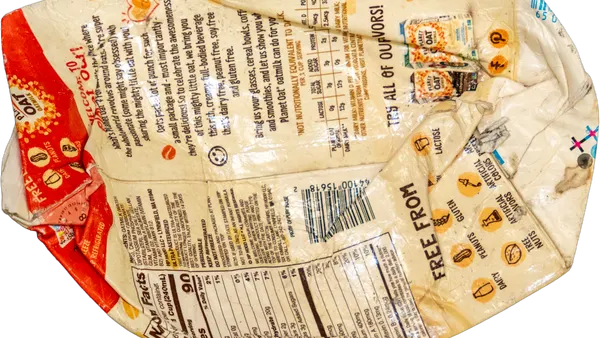
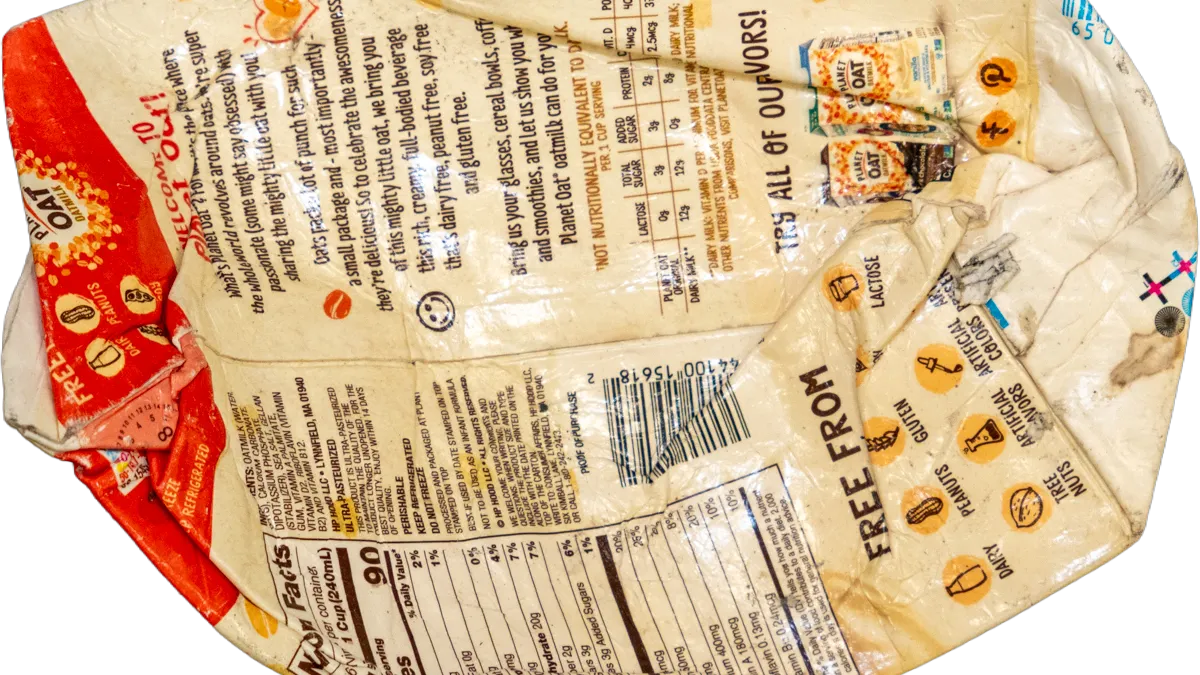
- A new open-source image library established by the Carton Council aims to collect and share images of food and beverage cartons the way they typically show up in MRFs: torn, dirty and squashed.
- The specialized image library is meant to help equipment providers and operators — particularly those with AI-powered recognition and sorting technology — more reliably identify cartons the way they actually show up their streams. Glacier is among the companies using the library to train its robotics.
- Cartons rarely make up more than 1% of inbound tons at MRFs across the country, said Brendon Holland, Carton Council’s communications manager. That means cartons may have fewer chances than other materials to show up in AI training datasets, which can reduce identification or sorting reliability.
Dive Insight:
AI-enabled robotics technologies are often trained on billions of images, and “more is more” when it comes to adding images that best represent the actual conditions at a MRF, said Margaret Link, a spokesperson for Glacier. That means photos of flattened, twisted cartons representing a range of brands and sizes are preferable over shiny retail images of those same products.
“When we don't have the entire picture of the real world, it means that things are getting missed. It means that the robot can't do its job as effectively,” she said. “That’s why we are crazy about trying to increase the breadth of the data that feeds our machine learning.”
The image library helps supplement Glacier’s existing in-house dataset, she said.
Glacier is the first company to use the database, but the Carton Council has already gotten requests from others who want to access it, too. The organization doesn’t endorse any specific company or technology and will work with any MRF equipment provider or operator that wants to either contribute images or test their equipment using the image library, Holland said.
The idea grew from a casual conversation last year between Carton Council and Glacier, Holland said. A Glacier representative had mentioned the company could use a broader database of carton images to help fine-tune operations at a California MRF where Glacier had just installed a new robot. Carton Council had partially funded the upgrade with a grant.
Carton Council sent over some photos taken during a bale audit it was conducting, which included material from around 10 different MRFs.
“But then we thought, ‘Well, why not create an open-source database to improve recycling for everyone?’” Holland said. “Everyone has their own in-house training data, but if we also can work with MRFs to get images that are representative from recovery screens that equipment providers don't often see, like regional differences, we can help improve the system across the board.”
The industry has worked to bring carton collection and recycling rates up in California to comply with provisions of “truth in labeling” law SB 343. After months of scrutiny over recycling rates under that law, cartons are again being sorted for recycling at several California MRFs.
Holland said more precise sorting technology is important across the country, not only to support carton end markets but also to improve residue streams and contamination issues in places where cartons aren’t accepted in curbside streams.
“A 1% increase in recovery might not seem like that huge a lever, but 1% reduced contamination would be huge,” he said. “We’re looking at it on the side of cleaning up bales so that markets are better able to process them. That, to us, is worth a considerable amount of effort to make it easier to recycle material that is collected.”