This is the latest installment in Waste Dive’s Biogas Monthly series.
Seven members of Congress recently joined together to urge the U.S. EPA to allow more maritime fuel uses to qualify for credits under the federal Renewable Fuel Standard, the latest push to open up a new market for biogas uses.
The letter, dated Oct. 15, comes as the industry continues to push for wider adoption of biofuels in the maritime sector, as the market for alternative fuels in the on-road transportation sector nears saturation.
Marine engines are divide into three categories for emissions regulations, with Category 3 considered the largest. The letter notes that the RFS already includes certain marine fuels as eligible under the RFS, but said there is insufficient regulatory clarity for fuel used in Category 3 engines, which power container ships, cruise ships and other large ships.
The representatives said their intent was to affirm the use of biofuels primarily on inland waterways or along U.S. coasts as eligible for credits under the RFS. They also said EPA should narrow the definition of ocean-going vessel to ensure that fuel “used predominantly in domestic commerce (including operations between U.S. ports or within U.S. coastal and inland waters) may qualify under the RFS regardless of whether a vessel uses a Category 3 engine.”
Doing so would further boost the domestic market for renewable natural gas, renewable diesel, ethanol, and other advanced biofuels, according to the letter.
The American Biogas Council praised the letter in a statement on Oct. 19, saying the proposed changes would open up a new market for liquefied natural gas produced from biogas and other renewable fuels.
“This helps put millions of tons of waste to beneficial use,” Patrick Serfass, ABC’s executive director, said in a statement.
Below is a selection of biogas news from October.
Ara Infrastructure acquires PNW digester firm
Private equity fund Ara Infrastructure acquired a majority stake in Pacific Ag, a crop residue supply and logistics company. The company is developing an anaerobic digestion plant processing agricultural waste in Washington.
The company is in the final stages of permitting its Sunnyside, Washington, RNG plant. Documents released by the host city indicate it would generate between 800,000 and 950,000 mmBtus of RNG annually, and would accept dairy manure from up to 25 local dairies as well as cellulosic feedstocks.
The project, which could become the nation’s largest, has received pushback from some local residents. It’s also not far from Divert’s Longview, Washington, anaerobic digestion plant. Divert is a portfolio company of Ara Partners, a separate strategy overseen by the same firm.
Purpose Energy partners with Danone for digester
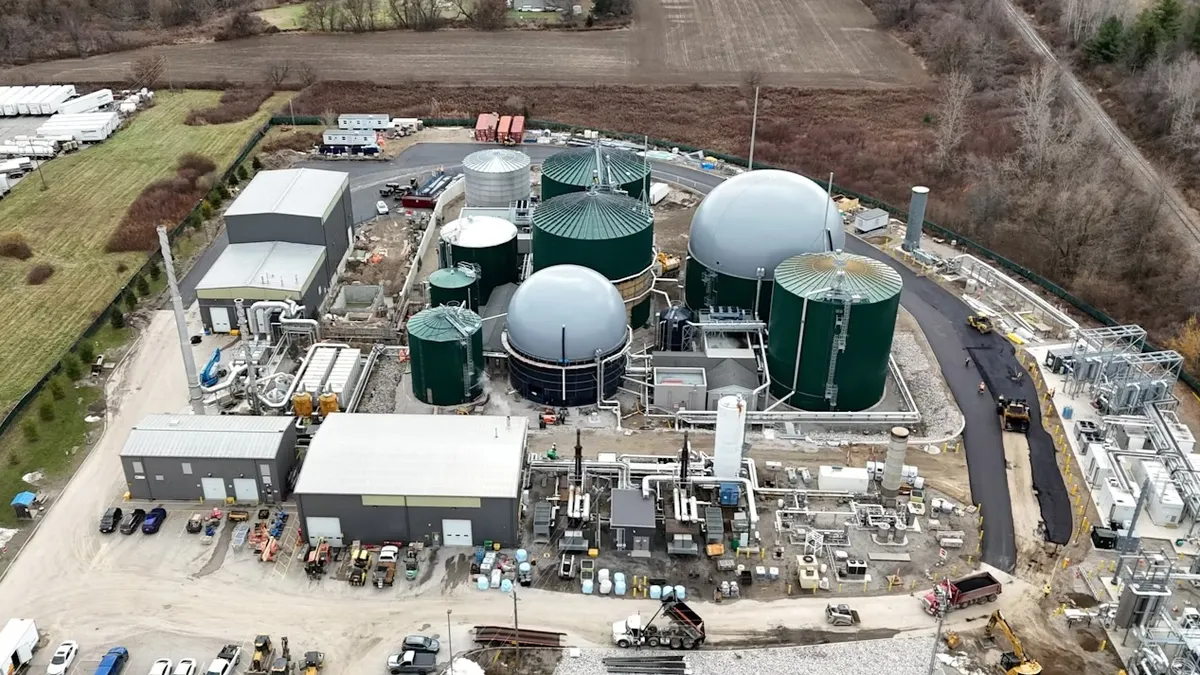
Purpose Energy announced plans to build a $40 million digester to process wastewater and organic food waste residuals piped directly from a Danone facility in Minster, Ohio. The facility, which represents the first collaboration between the two companies, would receive material piped directly from Danone’s largest U.S. yogurt manufacturing facility.
Once online, the project is designed to process up to 250,000 gallons per day and produce about 50,000 mmBtus of RNG annually. The gas will be used in a boiler on site and displace fossil-based natural gas.
"This project is an excellent example of PurposeEnergy's role in creating circularity benefits for food and beverage manufacturing," Eric Fitch, founder and CEO of Purpose Energy, said in a statement.
Purpose Energy is backed by infrastructure investor Quinbrook. Purpose has built several digesters in the Northeast, including a plant that offtakes residuals directly from ice cream manufacturer Ben & Jerry’s plant in St. Albans, Vermont.
Aemetis completes two new dairy digesters
Publicly traded Aemetis announced it began operations of two new dairy digesters in California. The sites are expected to feed into its central biogas processing facility in Keyes, California.
The company has built out a network of 14 digesters through its hub-and-spoke biogas strategy. The system takes advantage of state and federal incentive programs, including the California Low Carbon Fuel Standard and federal Renewable Fuel Standard.
The newest digesters also used equipment purchased from from NPL Construction, a subsidiary of infrastructure services company Centuri Holdings. Aemetis expects to use a dozen more cleanup and compression systems from that transaction to speed up development of additional digester installations.
The company is also planning to bring its first RNG fueling station online at Keyes in the coming weeks.
Waga Energy opens RNG plant at Best Way Disposal-owned landfill
Executives from Waga Energy and other project partners gathered to celebrate the ribbon cutting for a landfill-gas-to-energy plant at the Decatur Hills Landfill in Greensburg, Indiana. The landfill is owned by Best Way Disposal, a waste company based in Kalamazoo, Michigan.
The plant replaces a flare system for the landfill’s gas. Waga’s system can process up to 1,000 standard cubic feet per minute of gas and is expected to produce up to 203,000 mmBtus of RNG annually. Waga will own and operate the plant through a 20-year agreement.
Gas produced on site is injected into the CenterPoint natural gas grid and is sold to U.S. Energy.