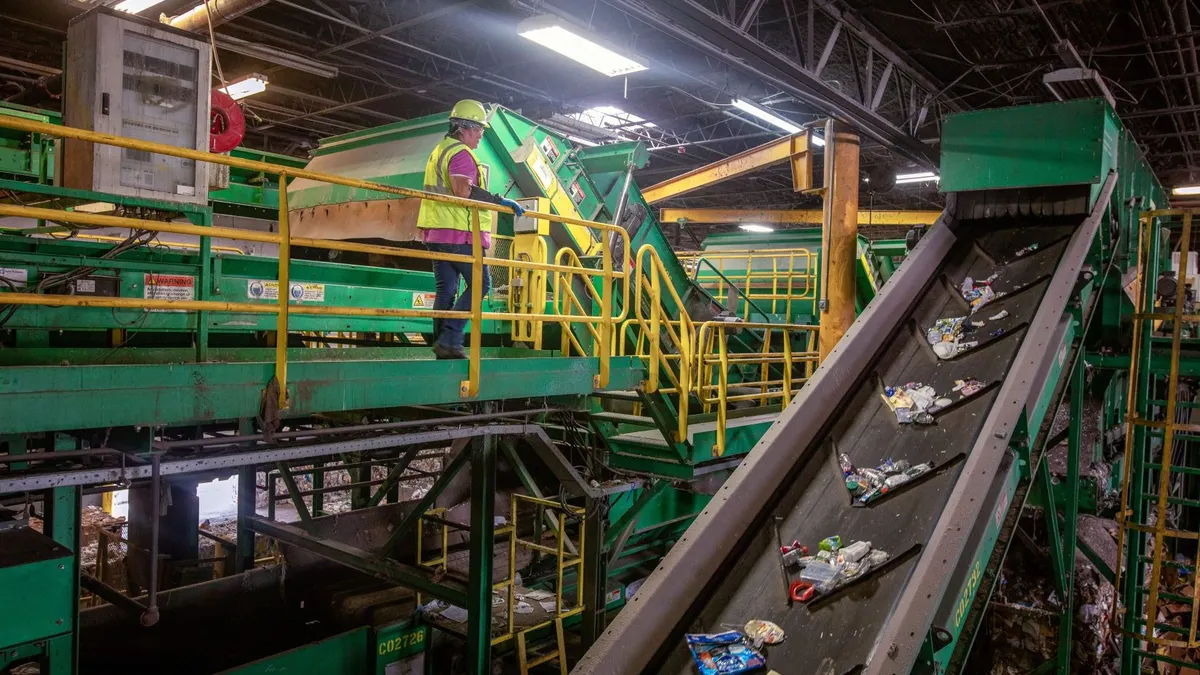
New MRF projects in California, Minnesota and Ontario aim to keep recyclables local by adding capacity and making operations more efficient. Some of these projects also benefited from state or local funding boosts or partnerships with extended producer responsibility groups.
Here’s a look at some recent MRF news across North America. Share your MRF construction, expansion and remodeling updates at waste.dive.editors@industrydive.com.
WM Canada opens Cambridge MRF to support EPR in Ontario
WM’s new MRF in Cambridge, Ontario, is now open. The facility is specifically designed to support Ontario’s updated EPR for packaging system, known as the Blue Box program. WM collaborated with Circular Materials, the program PRO, on the facility.
Owned and operated by WM, the MRF has 19 AI-assisted optical sorters and will process up to 160,000 metric tons of material a year, the equivalent of materials from 1.1 million households, Circular Materials said in a news release.
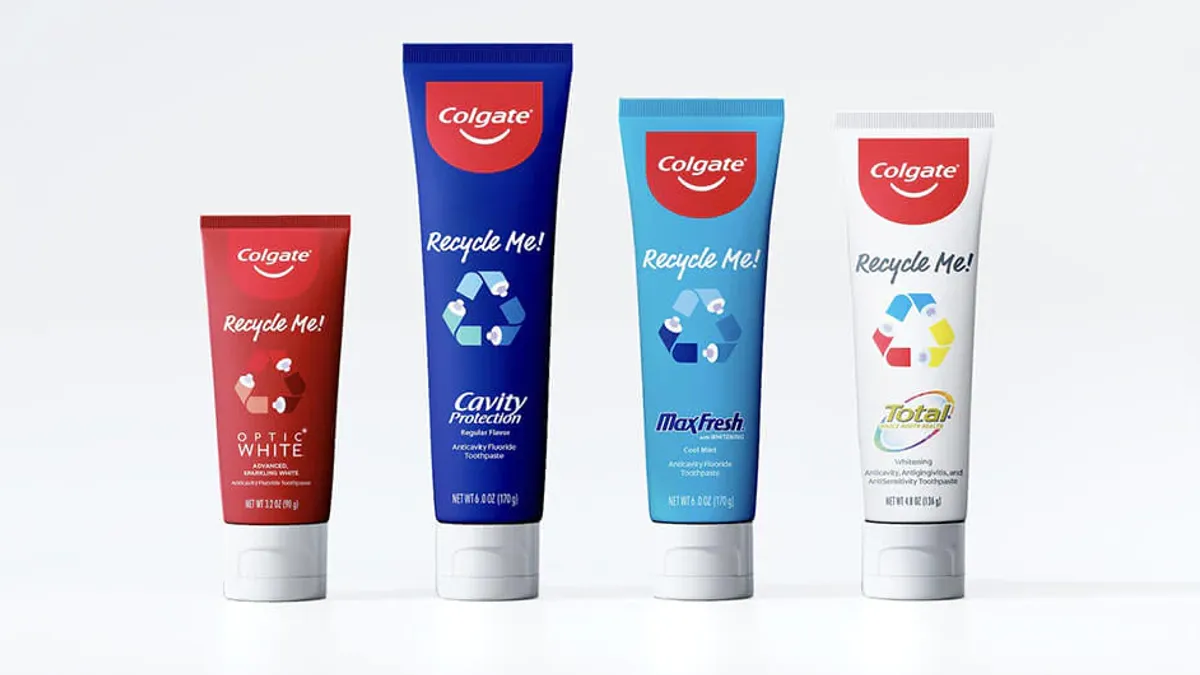
The facility will also help process materials from Ontario’s expanded and unified material list that was implemented province-wide in January, Circular Materials said. New accepted items include coffee cups, deodorant and toothpaste tubes, black plastic containers and frozen juice containers.
“Now that the province has completed its full transition to [EPR] for packaging and paper products, investments like this are critical to building a smarter, more efficient and more sustainable recycling system,” said Allen Langdon, CEO of Circular Materials, in a statement.
The building also has an education center that will offer guided tours and hands-on learning experiences to help the public understand the recycling system and how to accurately recycle, WM said.
The facility created 40 local jobs in operations, maintenance and technical services.
The MRF is part of a two-facility development plan in the Cambridge and the Greater Napanee region. Along with the new Napanee MRF, the two facilities will process about 30% of Ontario’s Blue Box materials. WM invested about $300 million Canadian dollars on the two facilities.
Mid-Valley Recycling reopens in California with $12 million in upgrades
Mid-Valley Recycling has remodeled and reopened its Fresno Commercial MRF. The $12 million upgrade includes six AI-powered robots from Glacier Robotics, which will also offer real-time data to monitor plant efficiency, the company said.
MVR also installed a new processing line capable of processing 25 tons per hour, CP Group said in a news release.
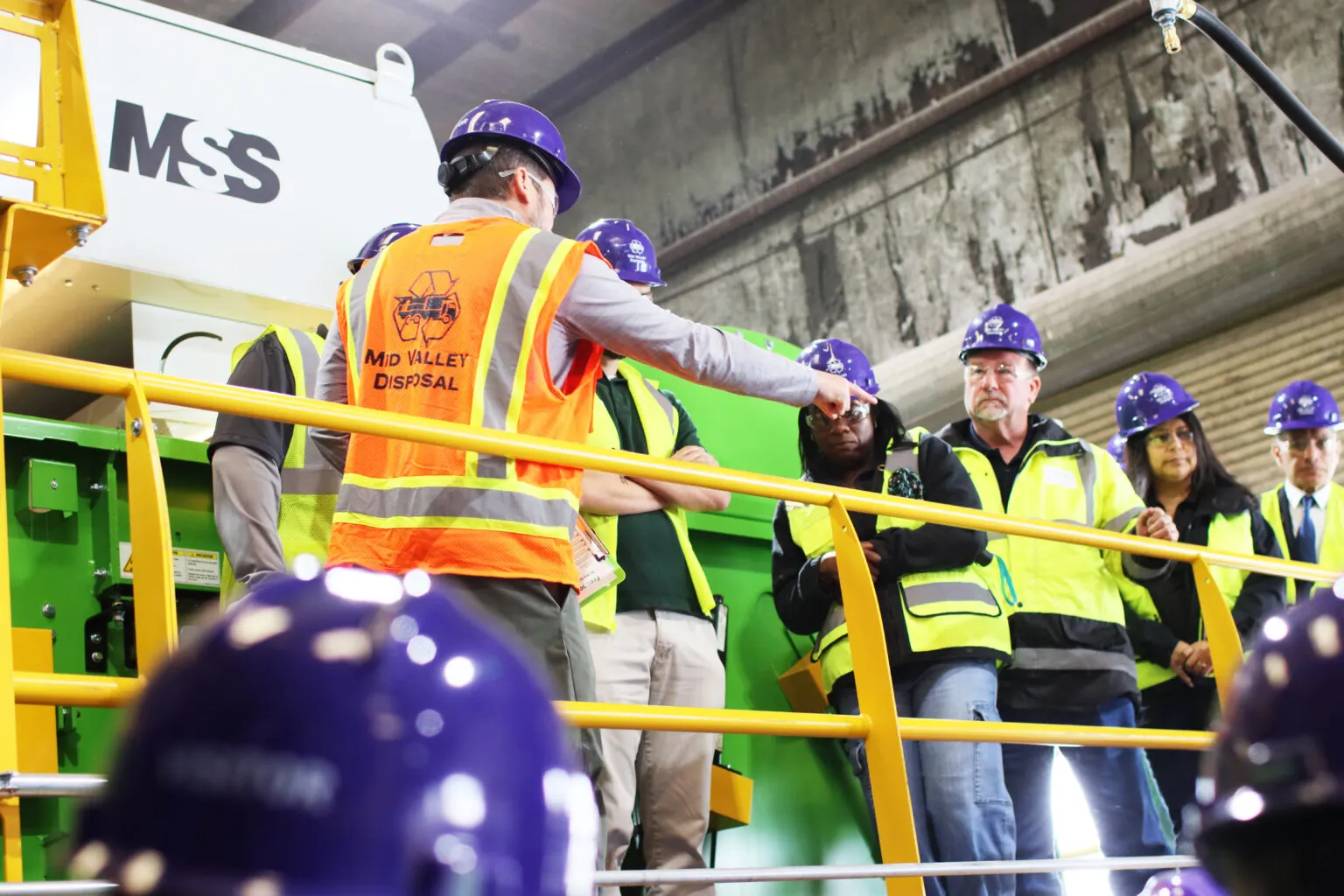
The new processing line will operate alongside MVR’s existing 35 TPH single stream system, which CP Group said it designed and installed at the same facility in 2017.
Together, the two lines can process both residential curbside material and commercial recyclables from the San Joaquin Valley, CP Group said.
Other new equipment includes an eddy current separator, a new drum feeder, auger screens, glass breaker screens and a drum magnet. There are also two new optical sorters: one for mixed paper and fiber, and another for plastics, CP Group said.
The upgrades were funded in part by a $4.5 million grant from CalRecycle as part of the Beverage Container Quality Infrastructure Grant Program which funds infrastructure improvements for recycling or drop-off collection programs.
“This is the future of how we manage materials — utilizing technologies to get the most out of our streams and put it back into circulation, and that is really what we are focused on in California,” said Cara Morgan, a deputy director of CalRecycle, in a statement.
The MRF originally opened in 2001, and volumes have steadily increased at the facility since then, said Abel Salazar Jr., manager of post-collections at Mid-Valley Disposal, the parent company of Mid-Valley Recycling, in a statement. In 2025, the facility processed 130,000 tons of material.
“These communities rely on us to not just collect it, the waste at the curbside or at the businesses, but they rely on us to process it and be a steward of the sustainability market here,” said Joseph Kalpakoff, president and CEO at Mid-Valley Disposal. “With the AI technology, with the optical sorters, we can process faster, we can have cleaner streams and reduce the residual that’s going back to the landfill.”
Anticipated Olmsted County facility aims to add MRF capacity in southeastern Minnesota
Olmsted County, Minnesota, broke ground on a new MRF, a move to process recyclables locally instead of sending them outside the region.
The state legislature approved $10 million for the project, which will span 49,000 square feet when completed, officials said during the groundbreaking on June 9. Currently, household recyclables are sent to MRFs in the Twin Cities area.
“Right now, there is no MRF in southeastern Minnesota,” said Mike Cook, associate director of the county’s Environmental Resources department, in a statement. “By building a regional MRF here in Olmsted County, we have the opportunity to work together with other counties, improve waste diversion, and move closer to our vision of Zero Wasted.”
The facility will be built next to the county-operated Olmsted Waste-to-Energy Facility. Diverting materials from that facility will help delay the need for its “costly” expansion and ultimately reduce operating costs there, the county said. It will also reduce the amount of ash sent from OWEF to the nearby Kalmar Landfill, the county said.
The MRF is expected to open in 2027.