
Biosolids incineration systems installed decades ago are reaching the end of their working life just as land application standards for Class A biosolids get tighter.
Utilities know these assets need to be replaced. The hard part is doing it without shutting down a treatment plant a city depends on every day.
Because you can’t put a wastewater plant on pause.
Constraints shape an entire project
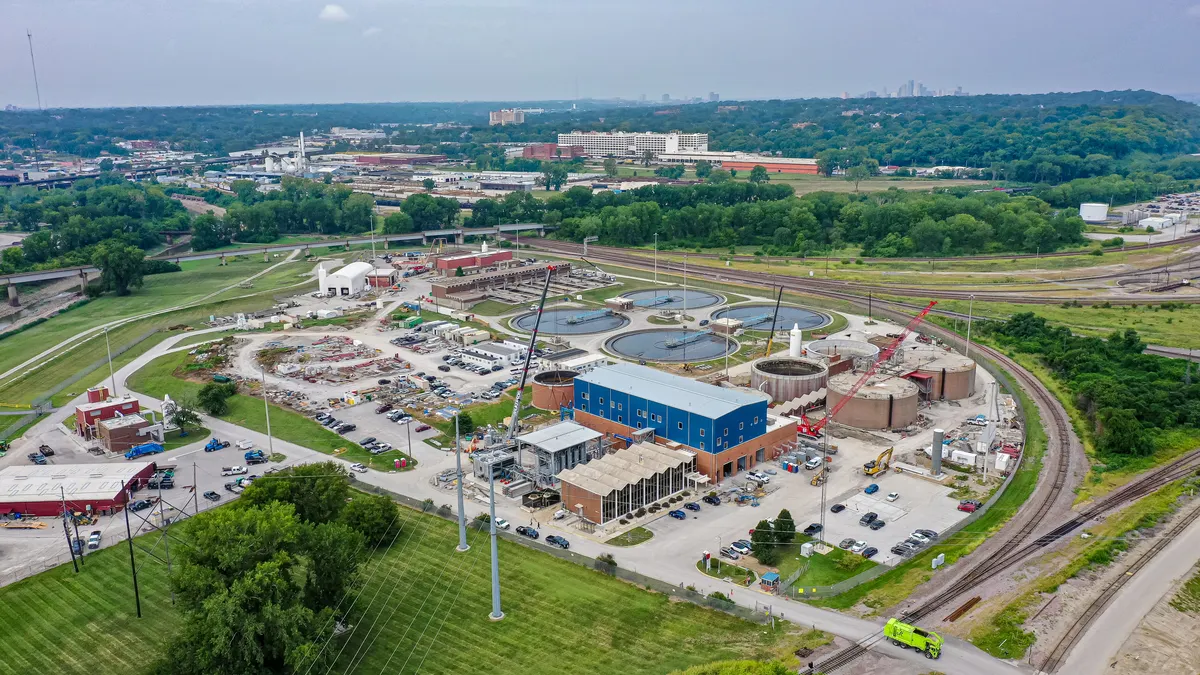
Kansas City's Blue River Wastewater Treatment Plant treats up to 120 million gallons of wastewater a day and handles biosolids from another two nearby facilities—with an incineration system dating back to the 1960s. It needed an overhaul, but the plant runs multiple treatment trains around the clock. The city simply couldn't afford to take it offline.
That’s the kind of constraint a design-bid-build framework isn’t built to absorb. When engineering and construction are procured as two separate contracts, risk tends to surface only after design is locked in and crews are already working. That’s a difficult position to be in when the plant can't stop running.
Now add a multi-year development schedule, evolving state and local regulatory requirements and a community that has to be kept in the loop the whole way through. The margin to tolerate late surprises gets very thin.
Design-build proves its worth
Kansas City Water Services Department chose a different route: collaborative design-build.
Black & Veatch served as designer alongside Goodwin Brothers Construction, with the two teams coordinating throughout the process. Technical risk was addressed as it emerged on site, instead of surfacing later as a change order.
The plant’s new system centers on one of the first large-scale thermal hydrolysis process (THP) installations in the Midwest, paired with an advanced anaerobic digestion platform that replaced the plant's legacy incinerator outright. Advanced building information modeling supported design coordination throughout, while construction and commissioning were staged in phases, including a multi-step commissioning sequence for the THP and digestion systems.
All that staging protected biological processes and regulatory compliance even as new infrastructure came online around an operating facility.
Reusing the footprint instead of starting over
Rather than building a new facility on undeveloped land, the project team constructed the new biosolids facility on the foundation of the demolished incineration building. Existing digesters, holding tanks, corridors and structural foundations were reused or upgraded wherever possible.
This reduced construction risk, minimized new civil work and allowed the plant to process more solids without adding new digester capacity. For a facility with no room to expand outward, building on what already existed was key to making the project feasible.
A project designed to be replicated
For utilities working under similar space, budget or permitting constraints—especially in dense urban setting where acquiring adjacent land isn’t realistic—Blue River is a model worth studying.
Today, Blue River produces up to 94 dry tons of Class A biosolids a day, stable and nutrient-rich enough for both agricultural and residential land application. Reduced reliance on incineration and landfilling for disposal now takes pressure off the plant’s long-term operating costs, too. The project added sidestream nutrient treatment to manage rising ammonia flows as digestion capacity increased, keeping the plant within permit limits. And captured biogas is now headed for beneficial reuse in the natural gas system.
A plant built to burn waste is now producing fuel for farms and yards.
The project was given Grand Prize in the 2026 Excellence in Environmental Engineering and Science Awards by the American Academy of Environmental Engineers and Scientists and ENR Midwest recognized it among the year’s Best Projects in the Water/Environment category. It has also been submitted for Envision Silver verification, a further step toward validating its sustainability and performance outcomes.
A model for what’s next
Blue River is one example of what collaborative delivery can do for a utility that can't afford downtime. Black & Veatch tailors design-build and progressive design-build models around each project's real constraints, whether that's an operating footprint that can't shut down or existing infrastructure worth saving instead of replacing.
Future-ready wastewater infrastructure needs Bolder Vision. See how integrated design-build delivery from Black & Veatch can help accelerate your next project.