Dive Brief:
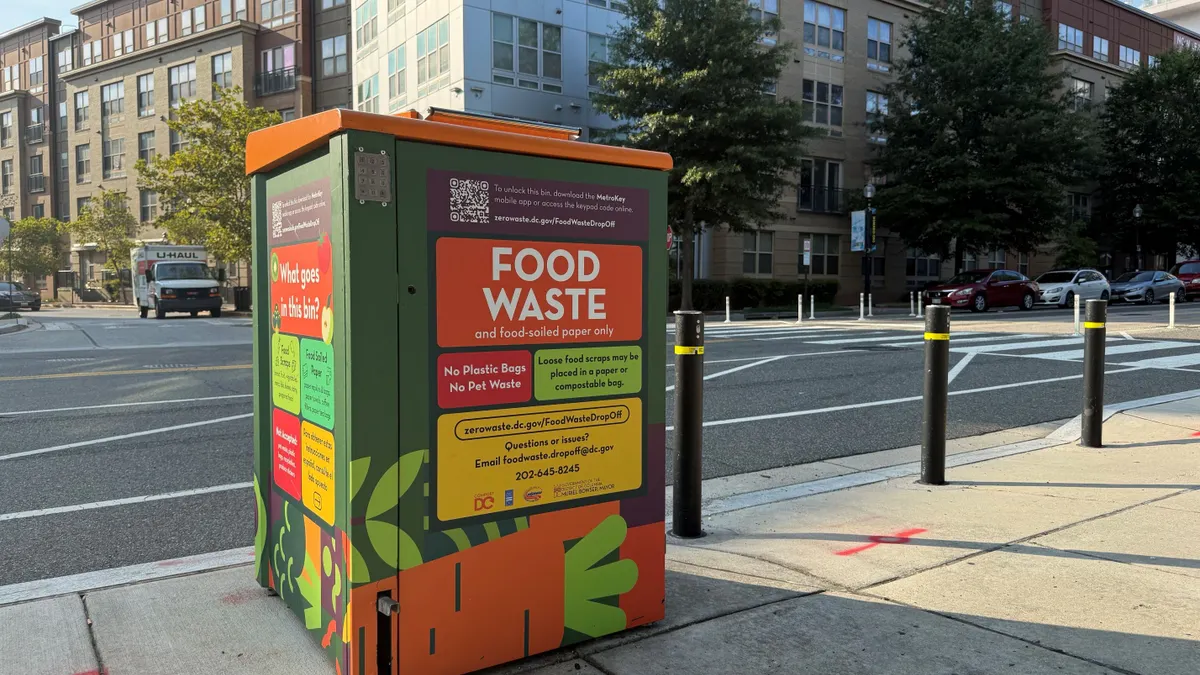
- Washington, D.C., is adding to its waste diversion infrastructure this fall by installing another 20 public “smart bins” for collecting food waste. There are already 31 bins throughout the city.
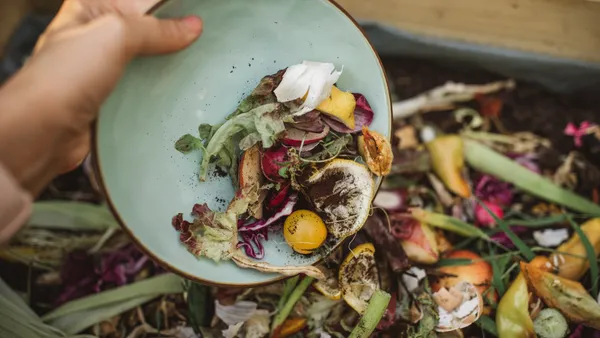
- Residents have dropped off more than 1 million pounds of food waste in the lockable public bins since the program launched in 2024, according to D.C.’s Department of Public Works. The program complements other composting efforts in the city, such as curbside collection for some homes and drop-off locations at area farmers markets.
- The aim with the sealed smart bins is to offer more composting options for residents living in multifamily housing.
Dive Insight:
The bin program expansion is part of a broader zero waste goal to divert 80% of the city’s waste away from landfills and incineration by 2040. Multifamily housing makes up the majority of living space in D.C., and DPW has been working to tailor composting solutions for apartment-dwellers in recent years to amplify those zero waste efforts.
D.C. already requires certain apartment building managers to provide adequate waste and recycling services to tenants. But residents who want to compost typically must take their food waste to a farmers market or purchase their own countertop composter if they don’t have easy access to a smart bin.
Users can find a nearby bin using an interactive map and unlock the lid using a key code, making the service available 24 hours a day, said John Johnson, program manager for D.C.’s Office of Waste Diversion. But residents are more likely to use the bin if it’s close to their home, “so the goal is to make sure that we have equitable distribution throughout the city,” he said.
The existing bins have become quite popular in the last 18 months, with about 10,000 residents signing up for keypad access, he said. DPW estimates it has collected more than 11 million pounds of food waste for composting since 2014 across all its collection programs, and 10% of that has come from the smart bins alone.
“It’s been a phenomenal program that's really making up that gap” in accessibility for residents, Johnson said.
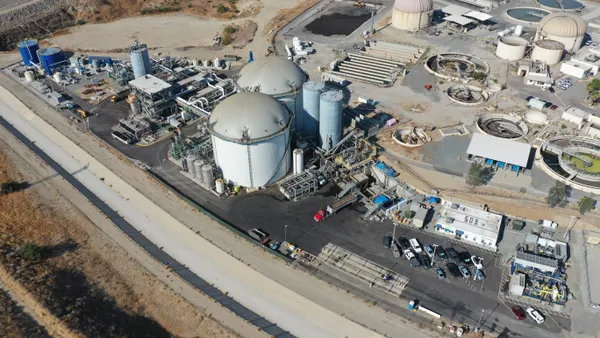
Compost Cab, a company that offers curbside collection services for homes, businesses and local governments, is the contractor that collects the material from the bins. The material goes to various composting and anaerobic digestion facilities in the region.
For residents who want to do the composting themselves, the city recently launched a series of how-to workshops and offers a rebate program for certain composting equipment, he added.
But the city also wants to expand programs that help divert other materials from disposal, Johnson said. It's using its popular food waste collection infrastructure as a way to do that.
Last week, the city launched a program at eight farmers market food waste drop-off sites that allows residents to also drop off used batteries. That’s also an opportunity to get the word out to residents about the city’s household hazardous waste events, he said.
D.C.’s zero waste plan, updated in 2024, calls for reducing the citywide solid waste stream by 18% and reducing greenhouse gas emissions by 1.38 million metric tons of carbon dioxide equivalent. Most of D.C.’s waste currently goes to the Reworld waste-to-energy facility near Lorton, Virginia, said D.C. Department of Public Works Director Anthony Crispino.
A longer-term project is to upgrade the city’s Benning Road transfer station, which has been decommissioned due to a fire. The city is working with the Office of Waste Diversion and D.C.’s neighborhood advisory boards to redesign and rebuild the facility as a more functional space to accommodate residents’ needs as the population continues to grow over the next 20 years, Crispino said.
The vision is for “a new green facility that is going to expand our capacity to accept composting materials, recycling, and other residential drop-off. There’s a whole plethora of ideas,” he said.
Correction: This story has been updated to reflect that Compost Cab is the collection service provider and organic material goes to multiple processing facilities in the region.