Large nations have historically relied on modeling tools to measure the greenhouse gas emissions released from their landfills. But that’s beginning to change as real-world monitoring technology grows more sophisticated and efforts ramp up to reduce emissions.
Several groups of researchers have begun to collect real-world emissions data, including FluxLab, the research group based at St. Francis Xavier University in Antigonish, Nova Scotia. Like other landfill monitoring outfits, FluxLab first honed its site monitoring capabilities at oil and gas facilities before turning to landfills.
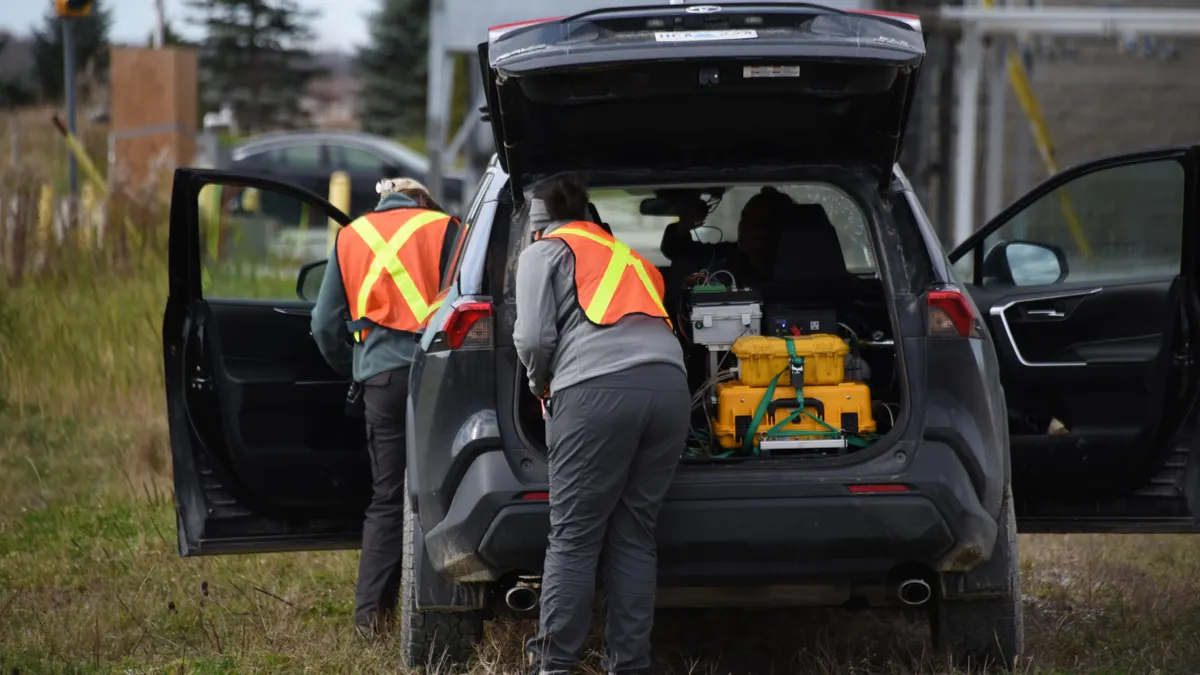
In 2022, the lab attached several instruments to a pair of Toyota Rav4s and sent crews on twin monthslong road trips to landfills across Canada. It also sent aircraft over some of those same sites to validate the information they collected. The data collected helped inform the country’s first federal landfill methane regulation, which was finalized last year.
In June, FluxLab published a peer-reviewed study based on those campaigns. Across 42 landfills, the group determined that measured emissions were often lower than predicted levels, particularly at sites in cold, arid environments. The researchers encountered plenty of challenges, including results that flew in the face of established models — and even an attempted car theft.
Dave Risk, FluxLab’s science lead, told Waste Dive during an interview that the findings shine a light on the impact of regional climate on landfill methane generation. The study also validated emerging understandings of landfill emissions, including the importance of gas capture on the working face and identifying opportunities to improve gas collection systems at small, municipal landfills.
This interview has been edited for clarity and brevity.
WASTE DIVE: Why is it important to get a more accurate picture of landfill methane generation at facilities across Canada?
DAVE RISK: This is a real question that came from our methane plan in Canada. We had never regulated emissions from landfills at a national level, any types of emissions. There is a desire in Canada to regulate, because we had big reduction goals that are associated with this particular sector. That's the starting point.
When you want to regulate, the question is: How good are our estimates at the present time? We did want to get an understanding of whether the starting point was good for considering regulation. Like, is our data set OK, or are we starting with the wrong assumptions? So that was the motivator for the study, and we worked with the federal government on it.
Environment and Climate Change Canada has estimated that the uncertainty for its methane emissions calculations is plus or minus 76% using the default parameters. Why is there such a wide range of uncertainty?
Canada obviously is a country of climate extremes. We have big seasonality. The default parameters that are used to generate the inventory estimates for the country are fairly generic ones that were generated through the Intergovernmental Panel on Climate Change, and they represent a more limited range of climate types and maybe not like subarctic, which we get into.
Because the provinces are the regulators of landfills, we don't, in a very clean way, pass data up to the federal government. The federal government gets its data largely by voluntary surveys from landfill operators. Because they're voluntary, not everybody submits information, and the information might be of variable quality because it's not reported in a regulatory context.
The federal government also doesn't know necessarily how old landfills are in some parts of the country, or how much waste they have accepted over time. We have much better estimates for some than others. That's also a driver of uncertainty.
You have both the modeling uncertainty, and then the data input uncertainty. So overall, that gives you pretty big uncertainty.
The data from your study was used to help inform the regulatory approach the Canadian federal government is taking to landfills. Tell me what your conversations were like with regulators, and what questions they were hoping you could help answer?
I think the main questions were just around the starting point. There's a real interest for regulators in understanding: Is the national estimate right, or the number per province? Are they reasonable?
On the site level, there's also a need from the regulators. Landfill operators have to use a particular method to report their emissions, to self-assess their emissions. We haven't had that in Canada. If we're to recommend that the industry uses a particular modeling tool to self assess their emissions, we should also assess whether that tool is working pretty well — even at the site level, not just at the national level or the provincial level — where we want to know if our targets are going to be reasonable or how to set them.
Your study’s methodology sounded almost like a landfill methane measurement caravan. Describe the experience of collecting these measurements.
The way that the original program happened, it was all very quick and based on work that we've already done with the federal government on oil and gas. They called us up and said they’re interested in understanding emission levels at landfills.
Within four months we're on the road. We had trucks on both sides of the country working towards one another going to two landfills per day, sometimes one landfill per day with transit days in between. We had an initial target list of 120 sites.
We also had aircraft going at the same time. We outfitted an aircraft with all the mass balance equipment that scientific aviation would use. We had the aircraft also picking away at some sites in Ontario and Quebec and Alberta on top of the truck campaigns and, in some cases, visiting the same sites at similar times.
All the work actually happened in a very short period of time. They're fast and furious and exciting campaigns.
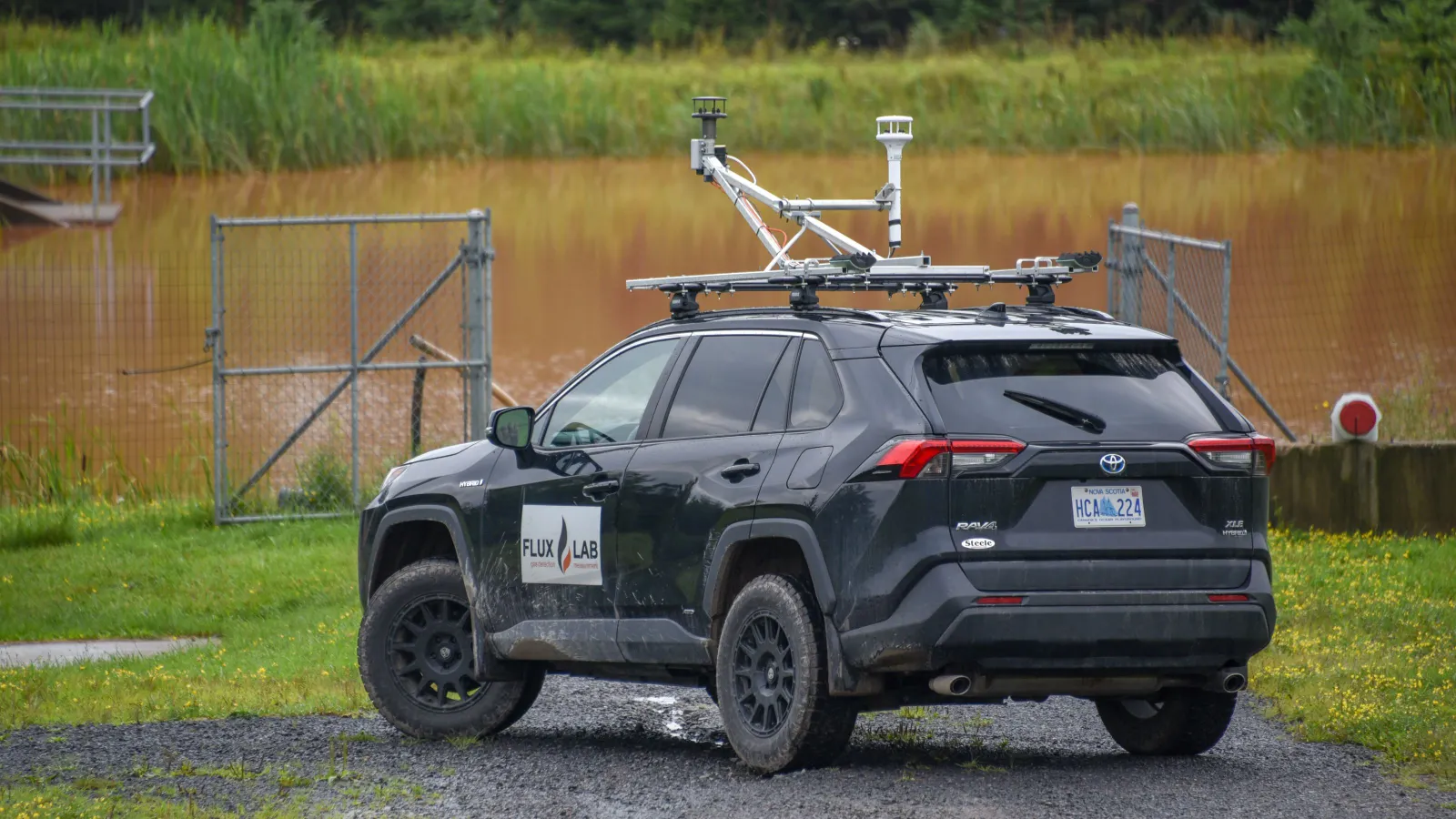
We probably were on the road for five months. There would be breaks. You'd have to have the right rotations for field teams, so people would be flying in and out from the two different vehicles working their way across the country, or from the aircraft.
We had it all reported out to Environment Climate Change Canada within nine months or something like that. So a really big research endeavor.
It's very hard on the head to do this kind of surveying. It's like being a truck driver, except you have to be just like thinking all the time as well.
All kinds of exciting stuff happens during big field campaigns. We had a truck stolen in Montreal at one point with all the instrumentation inside of it. Of course, it had all the stuff hanging off the roof, and they couldn't cut that off fast enough. The thieves ditched it, and it was recovered later that day.
Carbon Mapper was also conducting its work using airborne measurements to identify fugitive landfill methane emissions around the time of this study. How should we think about your measurements and data in the context of those other attempts to calculate emissions?
I think that we're seeing very much the same things, and that was very reassuring once we began comparing notes with Carbon Mapper.
That tells us there's some basic things that are important. Like the work face is more important than we've been giving it credit for at most landfills. I think that's a universal theme between our different studies. We do definitely see emissions across the gas-gathering system. Those emissions can sometimes even be higher, ironically, at sites that are actually producing RNG because they're optimizing the landfill characteristics to produce gas. That's creating issues, or it's just not as fully captured as it could be.
I think that there's some things that we dug into in this study that maybe haven't been done as much by the Carbon Mapper team. We definitely had a better focus on climate types because our inventory model at the federal level will continue to use the IPCC model. That's an area where we were able to offer something new.
We definitely saw that in the very arid regions, especially in cold arid landfills, there's just so little methane generation potential. The climate effect is important. For many of our climate types the IPCC model is fine, but certainly for central Canada it needs to be refined. That was one of the main differences in our studies.
We looked more at landfills of different sizes, too. We have a lot of landfills on the very small end of the size spectrum that wouldn't naturally be a target in a study in U.S. landfills, but it was a target for us. We found that some of those really small sites had quite low collection efficiencies, and it's probably mostly down to the relative size of the work face versus the area with the waste stack and collection. They're small, so they have a relatively large active face.
Your study found emission rates lower than what the IPCC’s current model would predict. Why is that?
We were measuring very different things at landfills than had been listed in the databases, so we had a lot of skepticism around our own measurements, both in the aircraft and in the truck, mostly because they didn't correspond to some of the predicted values that would be generated by the inventory model. We did a lot of self-reflecting over the next year, saying, “So is it our measurements, or is it really the quality of input data and the model itself that's being used to generate the estimates?”
What we decided over time really is that the estimates were wonky, and our measurements were actually quite good. We were able to do controlled releases. We tested our own tools at the same time. We really used that to increase our confidence. Then the aircraft and the truck were corresponding with one another, so that increased our confidence.
These kinds of landfill surveys hadn't been done in a lot of countries. When you see that your measurements don't really relate very well necessarily on a site-by-site basis to the predicted values, you really start scratching your head because there are a lot of unknowns. It took time for us to really develop confidence and for the paper to come out.
For most of the country, we see that emissions are about as expected. But we see, for sure, that the IPCC model is not doing well in the dry climate types. Most of the deviation from the expected values was in those very dry regions. That's just an area where the model has got the wrong decay constant for the situation.
Also, we have organics diversion for something like 95% of the population. I worry that sometimes in the IPCC models that the organics are treated in a more bulk sense, and that we don't take that into account. That might also be an explanatory variable for the fact that our emissions weren't higher than the IPCC in most places.
Your study also noted most of your measurements were taken in the summer. Do you think if you went back at a different time of year that you would see the same kinds of results?
In Canada, where we have pretty severe winters in some areas, we really have the surface microbiological activity shutting off in the winter. We don't have that oxidation potential that will remove methane in the winter time, so we can see that emissions can tick upward somewhat in the winter.
We had a fairly strong underestimate driven by some of these western landfills. I think if we look at it across Canada and all year round, the underestimate is less. We're working with Environment and Climate Change Canada on that now.
I think that we are under the official targets in terms of our actual emissions, but maybe — in part because of the winter factor — to less of a degree than we saw in this study. We have to be cautious about interpreting the results of this study and extrapolating it automatically to the inventory and saying we're quite a bit below. I don't think that's the case. I think that we're somewhat below.
Do you anticipate doing another road trip, basically to repeat it fully in the winter, or do you think you can make this happen without doing the same thing twice?
We do have more work proposed. It's proposed in particular for the dry regions of the country, and we hope we can get funding to do it.
We're the only country in the world to report measurement-informed oil and gas methane emissions. Would we do the same thing for the waste sector? I'm not really sure. I think it would be cool to at least have the capability to work in that direction.
Something that we have done well here in Canada is really apply measurement and just try to be objective about some of these sources so that we can manage them better. It's just easier to manage them if you have better data.