Dive Brief:
- Improving mobile phone reuse, repair and recycling initiatives in North America could recover an estimated $2.2 billion in critical minerals by 2040, according to a new report from the Ellen MacArthur Foundation.
- That starts with mobile phone companies designing devices that last longer and are easier to disassemble at end of life, making it easier for recyclers to separate out valuable materials, the report said.
- Other improvements include more convenient consumer drop-off locations, which make it easier to recycle old devices and give recyclers a more consistent stream of materials, the report says. Expanded secondary processing infrastructure is also needed, it says.
Dive Insight:
Boosting U.S. domestic supply chains for critical minerals used in electronics, batteries and magnets has become a key economic and manufacturing priority in recent years, partly because countries like China corner the market on certain minerals used to make those items.
That conversation has picked up speed in the last few months due to geopolitical factors such as tariffs and the war in Iran, which has strained supply chains for some industries. Those factors have also prompted lawmakers to introduce legislation, including a bill to formalize a national critical minerals recovery strategy.
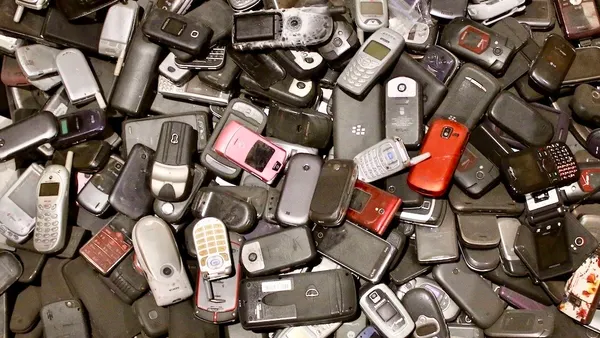
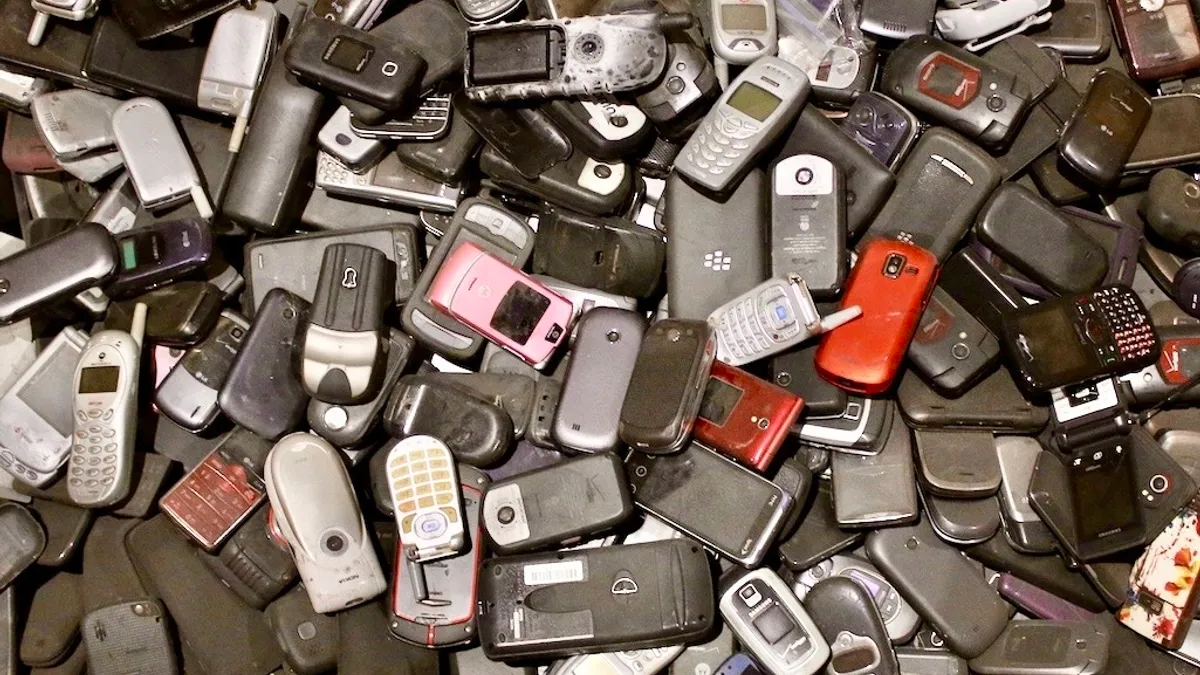
The Ellen MacArthur Foundation estimates that $67 billion in value is locked inside “hibernating devices” such as forgotten laptops or old phones tossed into junk drawers around the world. EMF also estimates U.S. residents are holding onto another 223 million “hibernating” smartphones that are left in drawers or boxes and have not been recycled or repaired, meaning the valuable materials inside aren’t reachable.
EMF’s latest report examines possible circular economy upgrades specifically for mobile phones in North America. In the U.S. alone, about 2 billion phones are expected to reach end of life by 2040, and only about half of those are expected to “enter reuse pathways” such as resale or refurbishment, according to the report. That’s in addition to another 410 million devices in Mexico and 180 million in Canada.
"Demand for the critical minerals powering the energy and digital transitions is surging, yet their supply chains remain linear, fragile and fragmented,” said Wen-Yu Weng, EMF’s executive lead for critical minerals, in a statement.
EMF calls for more formalized collection options for old phones to help remedy the situation and provide more reliable feedstocks for refurbishers and recyclers.
“When end-of-use phones fail to enter formal collection, downstream processors cannot secure consistent feedstock, and even advanced material recovery capacity is left undersupplied. The consequent losses push demand back upstream onto virgin extraction, reinforcing its costs and impacts,” the report states.
Many phone companies already offer deals for phone trade-ins, and some big box electronics stores offer drop-off options. But EMF points to emerging businesses to help broaden consumer options, such as mobile phone takeback company ecoATM. That company’s device drop-off kiosks can assess an old phone and pay a customer for the device immediately, and the devices are then sorted for resale and recycling.
The report also presses for better coordination across states and agencies that handle end-of-life electronics collection.
EMF calls for better coordination across the states with electronics-related extended producer responsibility laws. It notes that some states’ laws cover general electronics, while some exclude mobile phones, and some cover batteries embedded in the devices.
“These laws translate to numerous and inconsistent end-of-use pathways for mobile phones and limit how many devices enter formal collection and how much material is recovered at high value,” the report states.
The U.S. also has a patchwork of right-to-repair laws that EMF says keep devices like cell phones in circulation for longer because consumers have more access to repair parts and tools to fix their devices instead of disposing of them. But only a handful of U.S. states currently have right-to-repair laws that cover mobile phones, the report says.
For example, Minnesota’s statute covers a broad range of electronics, including mobile phones, but California, Colorado and New York “exempt specific product types or components essential to phone repair,” the report states.
Even in places where right-to-repair laws exist, EMF says mobile phone companies have not been incentivized to design their devices to make repairs easier or safer. “Access rights do not reliably translate into repair at scale without complementary eco-/ circular design requirements that raise the baseline for disassembly, durability and long-term support.”
If manufacturers designed phones that are easier to disassemble at end of life, recyclers could extract higher volumes of materials, the report says. Currently, hurdles like heavy glues or hard-to-detach batteries can make the disassembly process difficult, leading some recyclers to prioritize recovering aluminum or copper parts over harder-to-extract critical minerals.
Some others may choose to export the devices for further disassembly overseas, which does not help keep critical minerals in North America and could lead to environmental issues, the report says.
EMF also notes that North America has few secondary processors that can recover metals for reuse. For example, Glencore’s Horne Smelter in Quebec is one of the few in North America that can recover high‑value materials from printed circuit boards at a large scale. Aurubis has a newer facility in Georgia that can produce intermediate outputs, such as blister copper, but those require further refining, the report states.
This story first appeared in the Waste Dive: Recycling newsletter. Sign up for the weekly emails here.