Nth Cycle is rolling with the fast-changing landscape for critical minerals refining in the United States by taking advantage of geopolitical and economic factors that are bringing recycled critical minerals strategies into the spotlight.
Nth Cycle plans to become a publicly traded company by the end of the year by combining with Kensington Capital Acquisition Corp., a special purpose acquisition company.
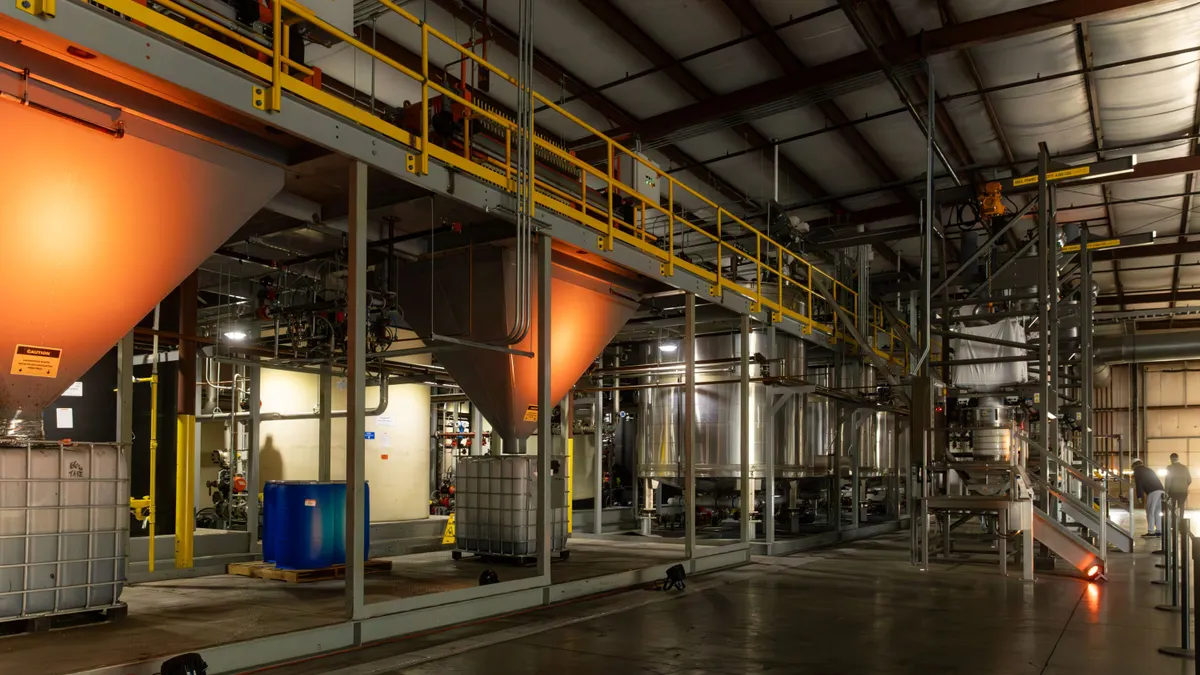
It’s also working on building Project SHIELD, Strategic Hub for Industrial Electroextraction & Logistics Defense, a critical mineral refinery that aims to process up to 24,000 metric tons of domestically sourced black mass each year through a partnership with Glencore and an offtake agreement with commodities group Trafigura. The project is supported by a $100 million Department of Energy grant.
Nth Cycle also is innovating via its modular Oyster system, which uses electricity and water to convert rare earth elements, copper, and battery metals into industrial-grade materials. Nth Cycle is licensing this modular technology to other companies, which install it at their facilities to help with the refining process.
Waste Dive talked with Nth Cycle CEO Megan O’Connor about what’s driving the company’s priorities in coming years, including U.S export restrictions on black mass and rising demand for critical minerals in AI, automotive and defense applications.
This conversation has been edited for clarity and brevity.
WASTE DIVE: Nth Cycle announced over the summer it would go public. Why go this route now, and why partner with a SPAC?
MEGAN O’CONNOR: We looked at a couple different routes, including going public the more traditional route, but we chose the de-SPAC path because it was really attractive to us to have a partner like Kensington. We really loved the idea of partnering with them, given their track record and their backgrounds, all in the automotive sector.
There's lots of folks in Kensington who were big names in the automotive space, and since that is one of our largest markets, it was attractive to have those skill sets along for the ride with Nth Cycle, especially as we grow and scale the company. We thought it was the most efficient way for us to raise the capital to basically go out and do what we want to do over the next several years, like Project SHIELD and some of the other work that we're doing in the other verticals.
How big a focus is the battery and black mass side of the business? Can we expect that that will become a bigger part of your business, considering you're building the Project SHIELD facility specifically for black mass?
Most people know us for our black mass refining capability, but Nth Cycle is a critical mineral refining company, so it's all around our refining platform. When I started the business back in 2017, the first minerals we actually looked at were rare earths, but back then there was not a ton of activity in the rare earth space in terms of onshoring the different pieces of the value chain.
In 2019, we got an NSF grant to look at the battery material side. We do not collect the batteries. We do not shred them. But we do take the black mass from them and chemically refine it. The market has evolved over the past several years, so we're very excited by Project SHIELD. We've been selected for the award negotiations, for up to $100 million, which is still in process. Project SHIELD should be a project of up to 24,000 tons of black mass. The site location is to be announced, hopefully, in the next couple months.
On the rare earth side, we work with both folks who are mining as well as the magnet recyclers. One of our partnerships there is with Ionic Rare Earths, and they are pretty solely focused on magnet recycling. Where Nth Cycle can help, and we have a joint development agreement with them, is that we integrate our Oyster system, an actual piece of hardware, into their flow sheet.
The goal is to deploy this technology with all these different partners. We're not trying to compete for feedstock, so we're not trying to compete for magnets or anything like that. We think we can create the most value by licensing our modules in the rare earth space to all these different companies.
Where do you see Nth Cycle within the broader critical minerals recycling and refining ecosystem in the U.S.? And how are you positioning yourself to take advantage of the current administration’s focus on critical minerals as a domestic security and focus on supply chain?
There's been a lot of changes in this space, particularly over the past two to three years. A lot of companies were previously trying to build out or vertically integrate all the way from collecting the batteries to shredding them into black mass to trying to build these very traditional refineries to process that black mass and the various products. You saw a slew of companies trying to produce sulfates or maybe precursor cathode active material or even further than pCAM, and a lot of those companies weren't successful in building those very traditional refineries.
Many of those companies don't exist anymore because they went bankrupt, or they pivoted strategies just to being on the recycling side. They weren't able to do the refining, but were going to continue to collect and shred the batteries, and then ship the black mass overseas.
These export controls of black mass came into place after the presidential determination in the summer. We’re very excited about that. We do think that policies like this will help with stopping the Chinese market manipulation happening with the price of something like black mass. The goal is to help bring feedstock back to the domestic market, and then stabilize pricing for U.S. companies in the refining space to be able to operate and fight against that market manipulation.
Nth Cycle is one of the few companies that we've seen in the space that has had a different strategy from the beginning, to solely focus on the refining. Traditional processing is hard to translate from what works well overseas to here from a cost, size, and permitting perspective, and a waste perspective. That's all of what we focused on for the past nine years. We're very excited to build up this capacity for black mass refining here in the states.
There’s this major gap we have in the midstream, so we're trying to develop this modular solution to really be able to cost effectively refine and do this midstream processing for these wonderful mining and recycled feedstocks.
For the Oyster system, the flexibility comes from not just what we can process, but also in how we work with these different companies because they all have different needs, and we want to be flexible with those needs.
In rare earth space, there are a lot of companies out there who already have access to magnets or have mines, and it doesn't necessarily make sense for Nth Cycle to try to compete for feedstock in the recycled space. We felt like the most value that we could provide is by licensing the physical Oyster system by dropping it into somebody else's facility versus building our own facility.
Eventually, we won't need to mine any more materials. We're very far off from that goal, but the name Nth Cycle came from the fact that these minerals don't degrade. As long as you have a way to refine them back into that original metal, you can use them an unlimited number of times. That's the goal and why we have all these different business models.
Typically people see minerals coming from mines. Now I think the U.S. government, and globally, people are realizing there's actually a lot of valuable minerals that we can start to pull out from recycled content.