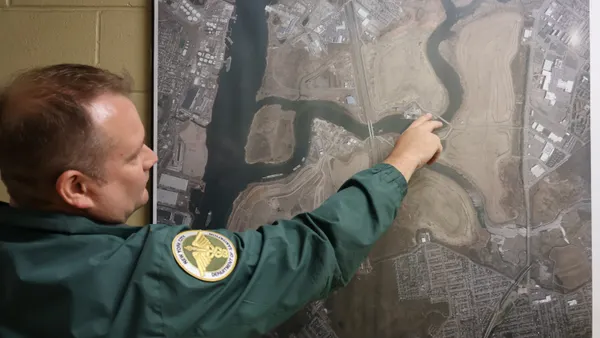
The Waste Dive team drew on a range of books, U.S. EPA reports, congressional analysis, archival issues of BioCycle and even one podcast for our series on the 50th anniversary of the Resource Conservation and Recovery Act.
Here’s our list of the resources that proved most pivotal to our reporting.
What else should we be reading, watching or listening to when it comes to RCRA and federal waste policy? Send us an email at waste.dive.editors@industrydive.com.
Waste industry history
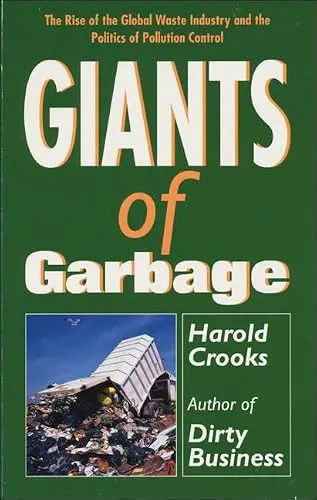
“Giants of Garbage: The Rise of the Global Waste Industry and the Politics of Pollution Control” by Harold Crooks (1993)
This book, a successor to 1983’s “Dirty Business,” is one of the seminal histories of the waste industry’s transformation from local operators to big business in the U.S. and Canada. It’s a must read for anyone interested in the early history of today’s two major companies and the many others that have since been acquired.
“Gone Tomorrow: The Hidden Life of Garbage” by Heather Rogers (2005)
Rogers’ chapter on corporate consolidation helped us think more deeply about how to frame RCRA’s role in the process.
“Waste Management: An American Corporate Success Story” by Timothy Jacobson (1993)
Jacobson’s book, which was supported by the company, had key details about the early days of WM’s landfill engineering plans and foray into hazardous waste via Chemical Waste Management. Read through for a fascinating account of the company’s international expansion that has since been scaled back. We’re still waiting for someone to make a miniseries about the Saudi Arabia chapter.
“The Waste Managers” by William J. Plunkett (2022)
Plunkett, a former WM employee, covers key details about the company’s evolution in the early days of RCRA.
“Doing the Doing” by Alan McKim (2023)
Clean Harbors founder Alan McKim’s autobiography offers a unique firsthand account of the ups and downs of scaling in the hazardous waste industry as a young entrepreneuer right as RCRA regulations unfolded in the ‘80s.
Federal and local waste regulation
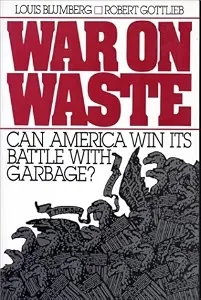
“War on Waste: Can America Win Its Battle With Garbage?” by Louis Blumberg and Robert Gottlieb (1989)
This book is one of our go-tos for understanding pre-RCRA federal waste policy, as well as the ins and outs of the law itself.
It also offers a detailed account of the boom period for solid waste incinerators in the ‘80s, including a failed attempt in Los Angeles.
“The Environmental Protection Agency: Asking the Wrong Questions from Nixon to Clinton” by Marc K. Landy, Marc J. Roberts and Stephen R. Thomas (1990)
We discovered this book in a footnote from “Garbage in the Cities” by Martin Melosi and it was a goldmine. The authors offer a highly detailed account of the fraught legal and political process surrounding RCRA in the ‘70s and ‘80s.
“Dumping in Dixie: Race, Class and Environmental Quality” by Robert D. Bullard (1990)
Bullard, often referred to as the “father of environmental justice,” got his start on the issue while studying the siting of solid waste facilities where he lived in Houston. He went on to spearhead a field of work that remains highly relevant to this day.
The closure of Fresh Kills Landfill
“Fresh Kills: A History of Consuming and Discarding in New York City” by Martin V. Melosi (2020)
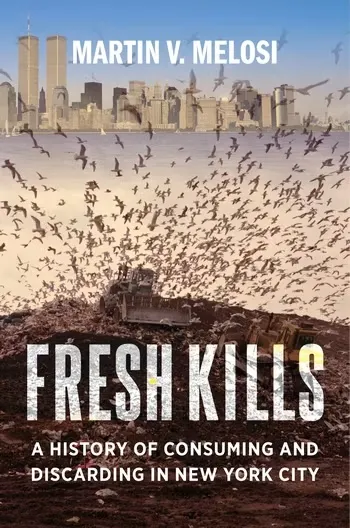
Melosi’s book is arguably the definitive history of the now-closed Fresh Kills Landfill, once the largest of its kind in the world. The book is well worth a read for any New York City history buff.
It also includes plenty of interesting details about the site’s role in 9/11 cleanup that we didn’t have space to include, as well as the long process to convert what was once the nation’s largest landfill into the city’s largest park.
“Fat of the Land: Garbage of New York — The Last Two Hundred Years” by Benjamin Miller (2000)
Miller, a former city policy official, offers an engaging narrative about the wild and always political history of New York City waste. This includes great details on how infamous urban planner Robert Moses played a role in siting the landfill.
“The Staten Island Problem” from Revisionist History (2026)
This entertaining, five-episode podcast series, hosted by Ben Naddaff-Hafrey, covers how the Staten Island secession movement was intertwined with the debate over closing Fresh Kills. It has great color about political battles during the Dinkins and Giuliani administrations, and an appearance from the Department of Sanitation’s anthropologist in residence.