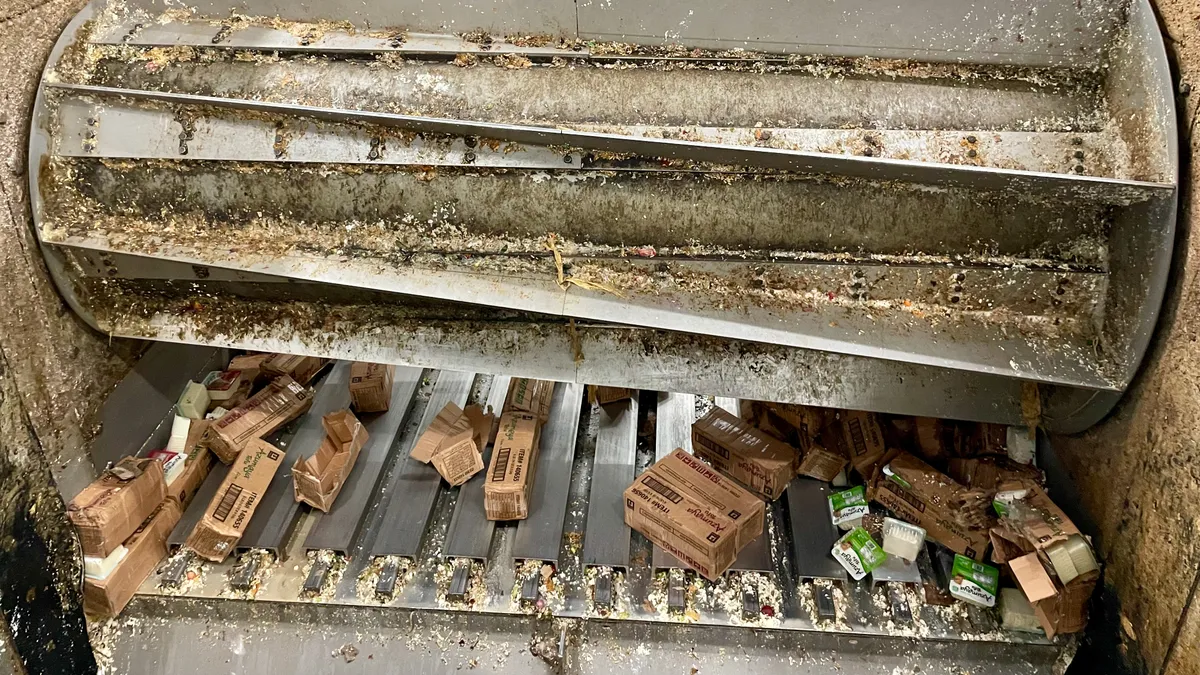
Officials in three states are advancing regulations for depackaging equipment, part of a first wave of rules designed to address the rising technology as organic material recovery advances.
But creating the first U.S. rules for the equipment comes with its share of challenges, speakers said Tuesday during a virtual panel hosted by organics publication BioCycle. Those include difficulties with accurate sampling for microplastics and the lack of a standardized measurement protocol for contamination.
BioCycle and the Natural Resources Defense Council conducted a survey of 23 states to find out what officials were doing to regulate depackaging, if anything. Just three states — Vermont, Washington and North Carolina — are actively crafting such regulations, but a lot of knowledge gaps remain, according to the survey.
Vermont and Washington have both begun to solicit public comments on proposals. Public reactions so far reveal potential conflicts between compost facilities, which want the cleanest feedstock possible, and anaerobic digesters, which require high volumes, though opinions vary.
Regulators are attempting to thread the needle. They believe that with the right rules in place, depackaging can unlock volumes of food waste that was not previously recovered, including pallets of preconsumer goods, without contaminating the materials streams that are often turned into soil products like compost.
"The question ... is not necessarily whether depackaging should exist, the question here is under what conditions should it scale and with what guardrails," said Paula Luu, managing director of BioCycle. "We're not in the business of creating new problems while trying to solve old ones."
Identifying knowledge gaps
North Carolina is in the beginning stages of developing depackaging rules. The state has begun requiring facilities to notify the state Department of Environmental Quality of depackaging activities so regulators can begin to understand the universe of existing sites, said Lauren Hill, a permitting engineer with the agency's Division of Waste Management.
DEQ was able to create that requirement because of broad language in the state’s environmental statutes that allows the agency to ask for notification of certain activities. That "wiggle room" can be helpful throughout the regulatory process by helping regulators collect basic information and then adapting to on-the-ground issues that arise like contamination or odors, Hill said.
Contamination has emerged as a regulatory focus. Nora Goldstein, BioCycle’s editorial chairperson and consulting principal, said that there is still no standardized measurement protocol for contamination in the slurries produced by depackagers. States may have microplastic contamination limits for physical compost or digestate, but rarely have contamination limits for incoming food waste streams or depackaged slurries, the survey found.
That can make it difficult to build accurate data on how clean the depackaged slurries really are, which will be important for regulators charged with protecting soil health, Goldstein said. Requiring contaminant data collection, which could be anonymized, would be a good first step in crafting smart regulation, she added.
"I think there's a reluctance, because of all the unknowns on the part of depackaging operators, to just volunteer to have slurries tested if it's not required," Goldstein said. "At the end of the day, without that information [regulation is] going to be blind."
Addressing contamination
Washington has been toying with a proper contaminant limit in its own draft rules. The state initially proposed a 2% contamination limit for feedstock entering compost facilities but relaxed that limit to 5% in its newest draft released in June. Regulators made that change partly in response to composters who believe they can handle the greater contamination, said Dawn Marie Maurer, a facilities specialist with the Washington Department of Ecology.
Meanwhile, Vermont has spent more than five years grappling with depackaging regulations. The state released draft solid waste rules in May that include a prohibition on the commingling of source-separated and packaged organics. The draft also tightened testing requirements for finished compost.
Given the amount of unknowns with depackaging, it can be better to err on the side of caution and enact stricter limits, said Ben Gauthier, an environmental analyst at the Vermont Agency of Natural Resources. Those rules can be relaxed later if depackagers are found not to be a source of harm, he added.
"We assume there's going to be some impacts, otherwise there wouldn't be a permit required," Gauthier said. "It's easier to be less stringent as you learn more about the process and the characteristics of the digestates or the slurries than it is to shut the gate valve off."
Regulators on the webinar were ambivalent on the role of depackaging in the organic waste ecosystem. They said the decision to allow such facilities to proliferate is downstream of a regulatory approach that values maximum recovery over contamination concerns. For now, language encouraging testing can help them understand this rising technology, panelists said.
"The trade-off is in the contamination," North Carolina’s Hill said. "Whether you're accepting contamination in the form of microplastics, or in what depackaging is able to prevent or take out... that is something I don't think we can make a fair determination on without the testing process for microplastics.”