
For most waste haulers, the margin pressure is easy to see.
Fuel. Labor. Maintenance. Customer churn. These are the numbers we watch closely because they show up on the P&L every month.
Collection costs alone typically run 60–80% of a hauling operation's total budget, which means even a 10% improvement in how that collection work gets done moves the needle more than almost any other lever available.
What most haulers don’t know is what their routes are actually costing them — not the miles, not the fuel, but the compounded daily inefficiency that never appears as a line item anywhere.
That’s where the real money is. And that’s exactly where most operators aren’t looking.
Miles are minutes. Minutes are money.
Every unnecessary mile on a route is a minute of drive time that didn’t need to happen. But the math goes further than fuel cost. Miles are minutes — and minutes, accumulated across a fleet day after day, translate directly into labor costs, equipment wear and capacity constraints that quietly cap your business from growing.
A 15-minute reduction in drive time per truck per day sounds modest. But 15 minutes isn’t just 15 minutes.
Across a fleet, 15 minutes per truck per day can become enough capacity to park a truck — without asking anyone to work faster, cut corners, skip a break, or add overtime. It’s the difference between a route that executes consistently every day and a route that’s always slightly behind.
Routes drift. Most operators don’t notice until it’s expensive.
Route optimization is one of the most frequently cited priorities in waste operations — and one of the most frequently deferred.
The reality is that routes drift over time. Customers are added and removed, service frequencies change, new developments reshape geography. A route that was well-designed three years ago may now be carrying inefficiency that no one has had time to formally address.
Natural customer churn alone — adds and losses that accumulate without corresponding route maintenance — is one of the most common sources of avoidable cost in hauling operations. Sometimes a full re-optimization is needed. Often, it’s a targeted adjustment to the handful of routes that have drifted the furthest. Either way, the opportunity is there — waiting.
What a routing expert actually looks like
Not all route optimization is created equal. A routing analyst with a software license can redraw lines on a map. What they can’t always tell you is whether those lines make sense for your specific operation.
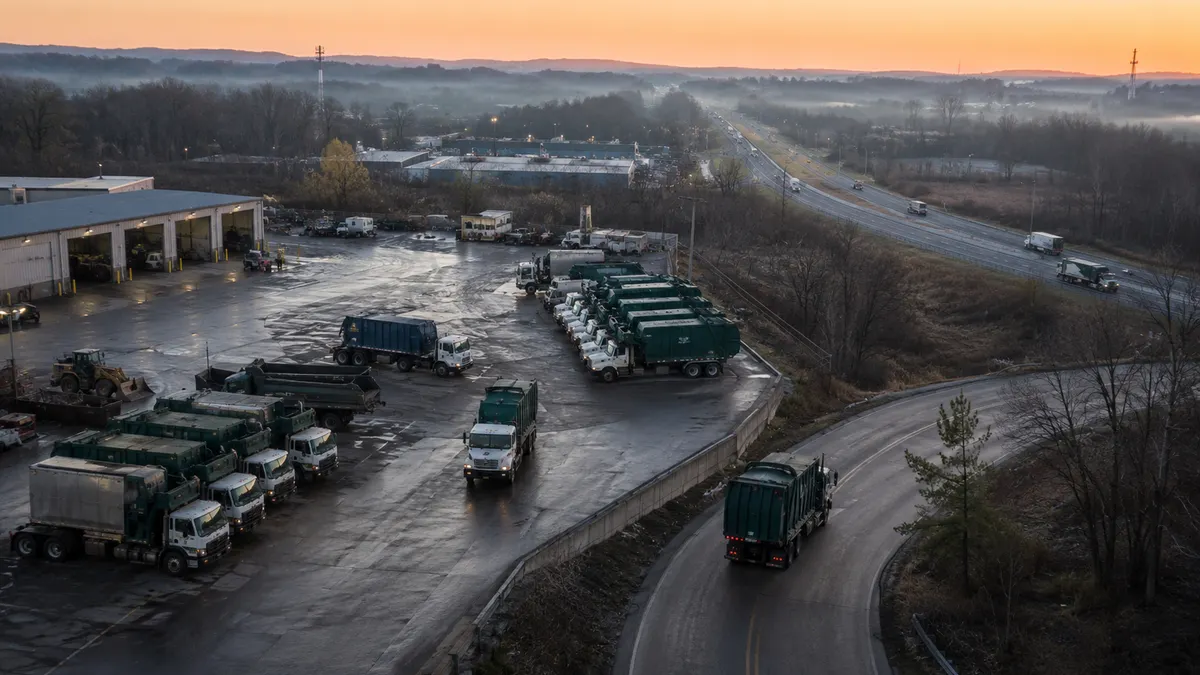
At Waste Streams Consolidated (WSC), route optimization is fieldwork first, software second. We have run operations, managed dispatchers and seen what happens in the yard when 20 trucks are trying to leave at once. That on-the-street context is what separates a route that looks good in software from one that actually executes consistently every day.
We bring both — the analytical rigor to design the right route and the operational experience to know whether it will actually work on the ground.
Example: The peak day problem
Here’s one most operators feel but rarely solve: the workload isn’t balanced across the week.
Monday is a disaster. Wednesday is manageable. Friday finishes early. The routes weren’t designed to distribute work evenly — they were built around geography, not capacity. And the result is a team that’s overwhelmed on peak days and underutilized on light ones.
Leveling workload day over day isn’t just an efficiency play. It creates predictability. Predictable days mean predictable costs, predictable overtime, predictable customer service. It’s one of the highest-leverage changes an operation can make.
When the route is right, but the operation isn’t
A well-designed route can still fail on the street. Not because the routing was wrong — but because the people and processes around it weren't built to support it.
Morning routines that set the day up for chaos instead of clarity. Drivers who don't have the information they need before they leave the yard. Debrief processes that don't exist or don't work. These are operational problems with a direct cost.
The haulers running the best operations aren't just routing better. They're operating better. They have disciplined morning routines, supervisors who know what good execution looks like and accountability frameworks that catch problems before they compound.
Most operators we talk to believe they're already running a tight ship — and they're usually right, relative to where they started. But familiarity creates blind spots. You stop noticing what's always been there. That's the opportunity an outside perspective finds.
A taste of what’s possible
We're not going to lay out the full methodology here. That's what the conversation is for.
What we will say is this: for most hauling operations, the combination of route optimization and operational discipline creates meaningful opportunities in the six-figure range — often visible within the first 90 days — before a full transformation program is even complete.
The inefficiency is there. It's in your routes, your yard, your peak days and the space between what your dispatchers know and what your drivers hear. It compounds quietly, every single day, until someone decides to go find it.
That's what we do.
If you're ready to find out what your routes are really costing you, start the conversation today.
Our free route optimization assessment is a conversation, not a sales pitch. We'll walk through your current routes, your daily operational flow, and where things tend to break down. By the end, you'll have a clear sense of where the inefficiency in your operation is likely hiding, and whether it's worth digging deeper together. Book your free route optimization assessment with Waste Streams Consolidated at wastestreams.co.