Dive Brief:
- New York River Watch, a group formed by clean water advocates in the state, is pushing the state’s Department of Environmental Conservation to strengthen a proposed rule for landfill leachate pre-treatment.
- In a report released earlier this month, the group identified more than 500 million gallons of leachate sent to municipal sewage treatment plants each year from 2019 to 2023. One-third of that was discharged from the plants to waterways used as drinking water sources.
- DEC is proposing to require active landfills to pretreat leachate for PFOA, PFOS and 1,4-dioxane. But the group would like to see more advanced pretreatment, as well as a broader reconsideration of the approval process for manufacturing chemicals.
Dive Insight:
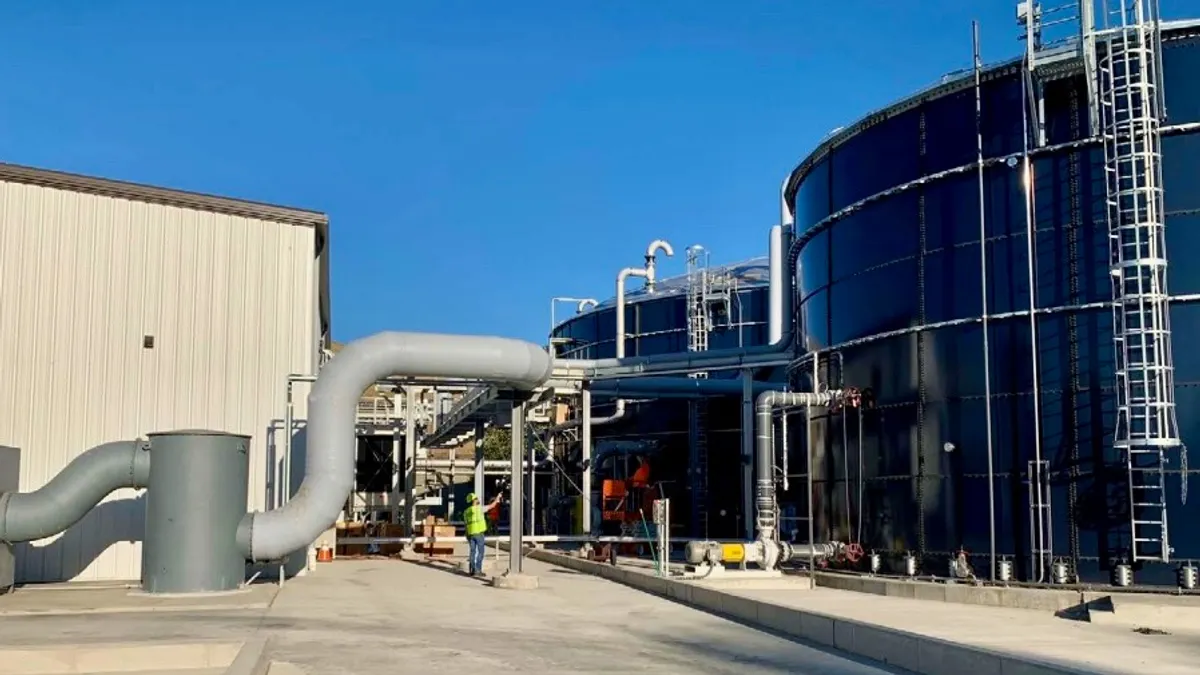
Modern leachate management practices were developed alongside sanitary landfill design. Federal rules require sanitary MSW landfills to be lined to prevent leachate from seeping into groundwater. But that leachate still needs to be collected and processed in some form before it’s returned to the environment.
For most landfills, leachate is sent to wastewater treatment plants, where it's mixed with water from lakes and streams before it's treated for concerns related to pH, oxygen levels and total suspended solids. Exact requirements can vary from site to site but are governed by permits issued through the U.S. EPA’s National Pollutant Discharge Elimination System or an equivalent state program. New York is one such state authorized by the EPA to run its own permit program.
In essence, landfill operators must ensure that their leachate does not contain contaminants that interfere with sewage treatment plants’ NPDES permits. Those permits could theoretically be tightened to treat for the wide variety of heavy metals, pharmaceutical ingredients, PFAS and other chemicals picked up by leachate as it percolates through a landfill's waste stack. But New York River Watch argues that the responsibility to manage those contaminants should move upstream to landfill operators, and eventually manufacturers themselves.
The question of responsibility for the chemicals also extends to landfill ownership. The report determined that about half of leachate discharged into the state's waterways was generated at landfills managed by three of the country’s largest private companies: WM, Waste Connections and Casella Waste Systems.
“They should bear some responsibility for this before the state just opens up the coffers and gives pilots or grants or public funds for these private companies to develop treatment facilities with technologies that are really new,” said Rebecca Martin, executive director and co-founder of New York River Watch.
The current system largely passes responsibility for treating contaminants downstream. Many sewage treatment plants operating today are not equipped to handle the wide range of contaminants found in leachate, especially since raw leachate is also full of organic materials, said Pat Byrne, an analyst at Bluefield Research. That makes typical treatment processes, such as reverse osmosis and granular activated carbon, difficult and expensive.
“The problem is, if you try and treat really high organic material water with that stuff, it's going to mess up that adsorptive capacity, and your costs go through the roof,” Byrne said.
The EPA sets minimum standards for contaminants passing from landfill leachate to public waterways, but it last updated those rules in 2000. At the time, the agency also decided that regulations should only apply to leachate discharged directly to streams. Non-hazardous waste landfills that discharged to publicly owned treatment works were not covered by the rule because the agency decided leachate did not generally interfere with POTW operations.
The EPA has signaled that it plans to update Effluent Limitation Guidelines for landfills soon, which could tighten requirements. Notably, the agency has acknowledged the importance of controlling certain PFAS chemicals that exit landfills through leachate.
At the state level, New York River Watch also takes issue with DEC’s plans for limited implementation of the leachate pretreatment requirements. As proposed, inactive landfills and landfills that close within two years of the rule's finalization would not be obligated to comply with the pretreatment rule. Yet a DEC study from 2024 found that groundwater at 68% of the state’s closed landfills had PFOA and PFOS concentrations higher than the drinking water standard.
The group would like to see inactive landfills covered under a rule. Those facilities are also likely discharging contaminants through their leachate, and covering them under regulation would allow municipalities responsible for their management to be eligible for funding, according to New York River Watch.
New York River Watch is pushing for an extension to the comment period to educate more communities downstream of landfills about the impact of leachate management rules. Long term, the group is also hoping regulators will think more critically about the approval process for chemicals in manufacturing, which often allows new substances to be used until they are proven harmful.
“We need to be taking a precautionary approach to this problem, and we need to be making sure that as much as possible we're getting this contamination out of the leachate,” said Martin.
DEC is taking comments on its rule until Sept. 9, with a public hearing on Sept. 2.