Dive Brief:
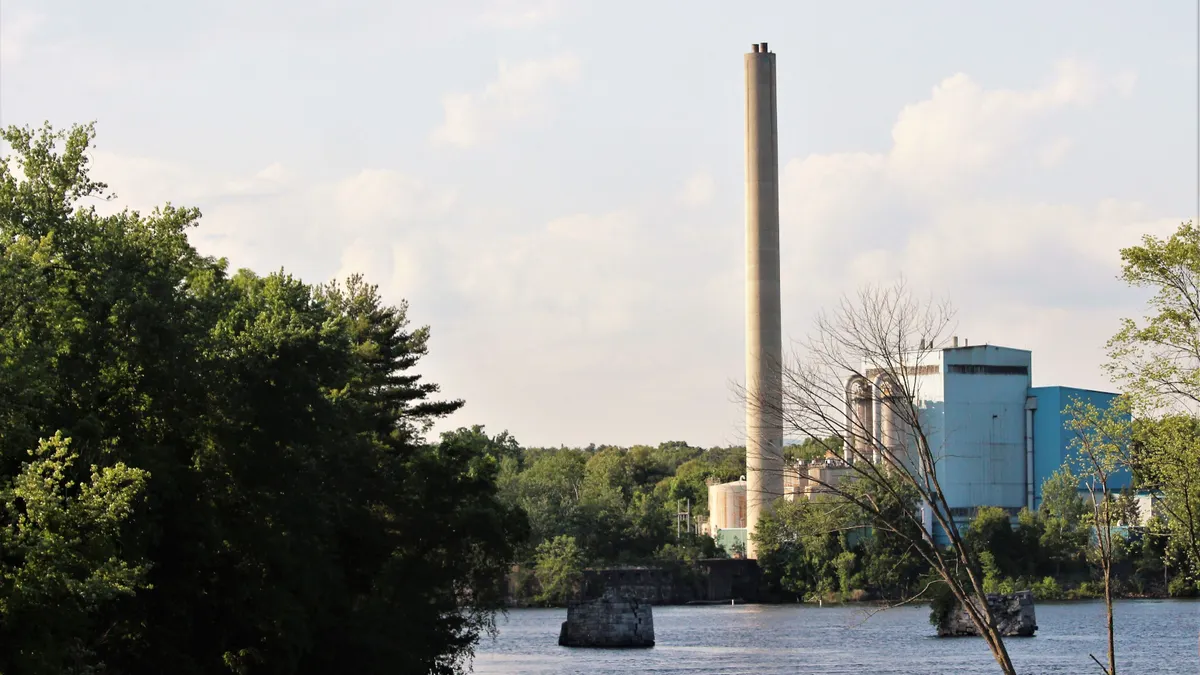
- Win Waste Innovations plans to close its Hudson Falls, New York, refuse-derived fuel facility. The company has operated the facility for decades as Wheelabrator Technologies, which acquired the facility outright from the Warren-Washington Industrial Development Agency in 2012.
- The Hudson Falls facility accepts up to 500 tons of waste per day which comes from 26 New York counties and seven other states, as well as Canada, according to the Energy Justice Network.
- An ordinance passed by the Village of Hudson Falls’ board of trustees in April attempted to set highly restrictive pollution limits for the facility. A spokesperson for Win Waste said that the company views that ordinance as unlawful, and that the decision to close the facility was based on unrelated cost considerations.
Dive Insight:
The facility is one of two operated by the company in the state and one of 10 total waste-to-energy facilities in New York. In recent years, some of those facilities have come under pressure from environmental advocates that want to see more stringent air pollution controls enacted.
Win Waste was formed in 2021 through the combination of Wheelabrator Technologies and Tunnel Hill Partners. Wheelabrator was a longtime operator of waste-to-energy facilities around the country, including the Hudson Falls facility. The company today has a portfolio of 12 waste-to-energy facilities, including the one in Hudson Falls.
Waste-to-energy facilities around the country have come under pressure from local advocates eager to reduce point source emissions. In March, the U.S. EPA also updated its air regulations for large municipal waste combustors like the Hudson Falls facility, setting stricter limits on particulate matter, nitrogen oxide, sulfur dioxide, hydrogen chloride, lead, cadmium, mercury, carbon monoxide and dioxins and furans.
That updated regulation changed the federal rules for the first time in 20 years. In the interim, some states had implemented their own, more strict emissions limits. Under the Clean Air Act, the EPA can delegate regulatory authority to state agencies if they submit a state implementation plan. Several states have done so, including New York. The state’s incinerator emissions rules were more stringent than the federal limits before this year's update.
The March federal update didn't go as far as a 2024 proposal that environmental groups had wanted to see implemented or strengthened further. Some groups, including the Energy Justice Network, have worked to pass laws at the local level to set even stricter limits than what states or the federal government require.
That led to Hudson Falls passing its own clean air ordinance in April. The law requires continuous monitoring of 19 pollutants, compared to the three required in state law, and set significantly lower limits on cadmium, lead, nitrogen oxides and others.
In a release celebrating the planned closure of the Hudson Falls facility, the Energy Justice Network wrote that residents had been attending local board meetings for years seeking a pathway to shut down the facility.
“They have been fed up for years with the air pollution coming from the facility and related health conditions and quality of life issues plaguing their neighborhoods,” the group wrote.
When the local ordinance was passed, Win Waste was actively reviewing the facility's air permit to further reduce nitrogen oxide emissions, according to Mary Urban, director of communications and community engagement. It recently received a draft air permit renewal.
Win Waste views the Hudson Falls ordinance as an "unlawful overreach by local government," since the New York Department of Environmental Conservation serves as the air quality permitting authority as designated by the federal EPA.
But after the federal government updated its own regulations, the company determined it would be too expensive to upgrade the facility’s emissions control technologies, Urban wrote in an emailed statement. That would include replacing the facility’s electrostatic precipitator and installing nitrogen oxide control technologies like selective non-catalytic reduction, which Win Waste uses at other sites.
The availability of other disposal options or transfer stations in the area meant that tip fees likely couldn’t be raised high enough to cover those investments at the Hudson Falls facility. Win Waste is shifting its focus in New York to its Westchester plant, where it is planning upgrades.
"The decision to seek retirement of the Hudson Falls facility had nothing to do with the Village's emissions ordinance. The facility's future has been under review for several years because, unlike Win Waste's other waste-to-energy facilities, Hudson Falls has a unique design that presents challenges for future improvements needed to meet anticipated federal emissions standards," Urban said.
Other municipalities have encountered challenges after setting strict limits on incineration. In Baltimore, a federal judge ruled that the city’s Clean Air Act had exceeded federal and state regulatory authorities. The city initially appealed that determination, but withdrew its appeal after reaching a deal with Win Waste to tighten pollution controls at an incinerator in the city.
The Hudson Falls facility’s closure still requires approval from the New York Independent System Operator, which oversees power grid reliability. With approval, the company plans to shutter the facility by the end of the year.